Materials don't end with disposal: traceability and digital identity to track new production cycles
Most traditional identification systems were designed to track products as long as they have commercial value within a given supply chain. SKUs, barcodes, product codes, lot numbers, and invoices help identify what has been produced, stored, transported, and sold. But there is one question that many of these systems were not designed to address: What happens to a material’s identity when the product ceases to fulfill its original function and enters another production cycle?
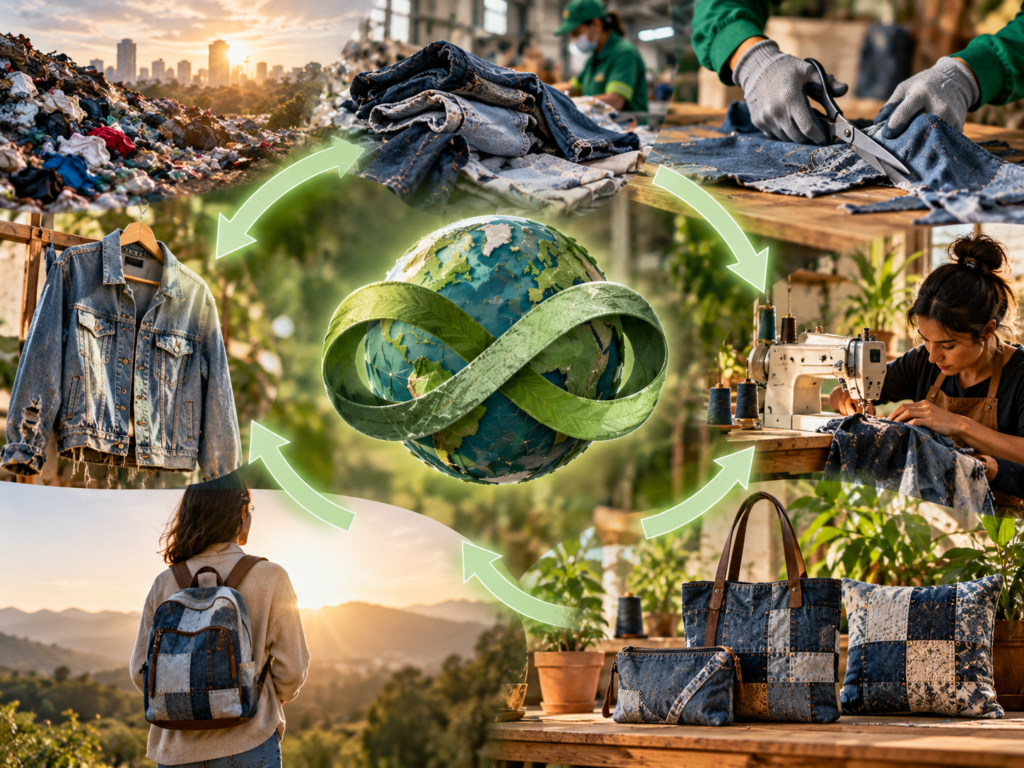
In the linear economy, this issue was of lesser importance because disposal was often treated as the end of a product’s life cycle. In the circular economy, the premise changes. A product can be disassembled, its components can be recovered, and different materials can feed into new cycles. A pair of jeans can be turned into a purse; a shirt can provide fabric for patchwork; wood can be recovered and used in furniture; glass can take on a new decorative function. The material continues to exist, but the information that explains its life cycle often disappears.
Between two cycles, there is a gap in information
Imagine a piece of clothing that, after years of use, ends up in an upcycling project. It is sanitized, taken apart, and separated into pieces. The main fabric is used to make a bag, while other pieces are turned into smaller accessories. The button can be reused, and certain components can be sent on to another process.
Physically, there was continuity. In terms of information, there may have been a complete break.
The new product will be registered under a different name, SKU, and description. If no link is established between the previous material and the current product, the chain loses the ability to trace that transformation. We know that reuse occurs, but we cannot necessarily demonstrate how it happened.
This problem becomes even more complex when a material goes through three, four, or more cycles.
Digital Identity Beyond the SKU
It is in this context that the concept of a product’s digital identity can take on a broader role. Rather than merely identifying the item for commercial purposes, a digital identity can organize information related to its origin, composition, production, authorship, territory, and relevant documents and events throughout its life cycle.
In SUIDChain™, this identity is structured through the SUID. The goal is to create a digital reference capable of linking different pieces of information related to the product and its lifecycle. For circular supply chains, this opens up the possibility of recording relationships between products, materials, and transformations.
An upcycled product could be linked to the batch of recovered materials used in its manufacture. That batch could, in turn, include information on its origin, supplier, date of receipt, and available documentation.
This is not to say that all chains will be able to fully reconstruct the history of each material. The point is to preserve what is known and documented.
Patchwork and Identity Formed from Fragments
In patchwork, the product’s very identity is built on the combination of multiple elements. A quilt may incorporate fabrics from different batches, time periods, and suppliers. The challenge of traceability, therefore, is not simply to identify a primary raw material, but to map out its composition.
This can be done at different levels. A collection can be linked to specific batches of reclaimed fabrics. A specific product can indicate which groups of materials were used. Photographs and production records can supplement this information.
Digital identity does not need to replace the artisan’s expertise or turn the manual process into a bureaucratic operation. On the contrary, it should be designed to capture relevant information without disrupting the productive dynamics that make that product possible.
Authorship is also part of the new cycle
When materials are transformed by hand, there is a dimension that conventional systems often overlook: authorship. A craftsperson does not merely process raw materials. She makes decisions about composition, technique, form, finish, and function.
In upcycling, this sense of authorship can be even more evident because the transformation requires interpreting the limitations and possibilities of the existing material. Two people can be given exactly the same set of scraps and still produce completely different objects.
Recording who carried out this transformation helps preserve an important aspect of the product’s identity. In supply chains based on communities, associations, or cooperatives, it may also be important to document the territory and the production group associated with the item.
SUIDPass: The Physical Product as a Gateway
SUIDPass creates a link between digital identity and the physical object using a QR code. Through this link, selected information can accompany the product even after it leaves its original production environment and enters marketplaces, stores, trade shows, or international markets.
For circular products, this continuity is especially important. A consumer who comes across an item years later can access information that would normally have been lost along with the original packaging or through changes in distributors.
The QR code, however, should not be confused with the passport itself. It functions as a gateway. What determines the value of this infrastructure is the data, relationships, and evidence that underpin it.
When thousands of identities start talking to each other
A product's individual identity represents only part of the opportunity. When multiple products have structured information, it becomes possible to analyze patterns.
SUID Intelligence broadens this perspective by working with data related to trajectories, life cycles, commercial presence, and market signals. For an organization operating within a circular economy, this can provide a broader view of materials, products, and channels.
What types of reclaimed materials appear most frequently? Which products use certain batches? What techniques are associated with specific regions? In which markets do the products appear? How do different collections perform commercially?
Traceability is no longer just a reference tool; it has become the foundation of intelligence.
From the region to international markets
For artisans, cooperatives, and upcycling brands, a digital identity can also facilitate communication with buyers who are far from the product’s place of origin. In an international marketplace, buyers and producers often never meet in person. The product must convey some of the information that, in a face-to-face sale, could be explained directly by the person who made it.
But identity and storytelling alone do not solve the challenge of internationalization. The SERX—SUIDChain Export Readiness Index—complements these efforts by helping organizations assess their readiness to enter international markets.
A circular supply chain may have significant inherent value but still need to develop commercial, documentation, and logistics processes before expanding.
Create a note for the article
The circular economy aims to extend the use of resources. Digital identity can also help extend their memory.
This memory does not need to be perfect or complete. In real chains of evidence, there will be gaps. The important thing is to be able to distinguish between known information, stated information, and information supported by different types of evidence.
When a piece of fabric is transformed from clothing into a bag and then into another product, it takes on different commercial identities. A digital infrastructure can establish connections between these stages without pretending they are the same.
Perhaps one of the greatest challenges of circularity is precisely this: building systems capable of recognizing that a product may come to an end, while its materials live on.
If matter can go through new cycles, its identity can also learn to go through them.