Supplier Declaration of Conformity: The Challenge for Artisanal, Natural, and Bioeconomy Supply Chains
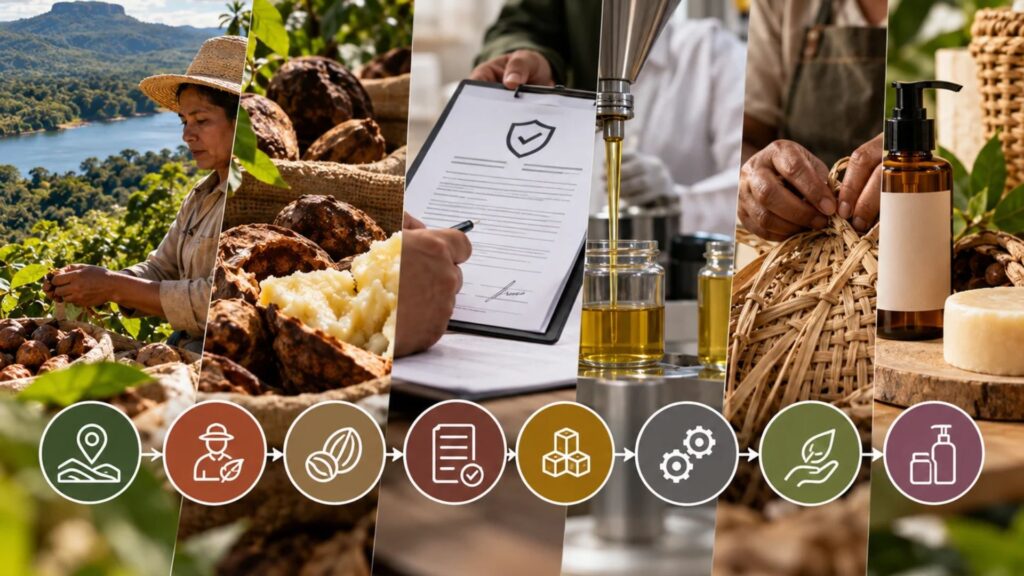
In a highly structured industrial supply chain, discussing a supplier’s declaration of conformity may seem like a natural part of the routine. There are purchasing and quality departments, technical specifications, approved suppliers, management systems, contracts, production orders, lot numbers, tests, documents, and procedures to track what enters and leaves the factory. But the picture changes dramatically when we step outside that world and look at artisanal, natural, and bioeconomy products.
A community association may supply a fiber. An independent artisan may produce a piece. A seed used in a piece of bio-jewelry may follow a supply chain completely different from that of an industrial component. A vegetable oil may originate in a socio-biodiversity area, undergo processing, transformation, and formulation before becoming a cosmetic product. A basket, a lamp, a handwoven fabric, a decorative item, or a natural ingredient can carry immense richness of origin and, at the same time, have a much less structured documentation chain.
It is precisely in this context that the discussion regarding the supplier’s declaration of conformity becomes interesting. Not because it is reasonable to require a small producer to have the same administrative structure as a large manufacturer, but because markets that are increasingly evidence-based pose a question to these supply chains: how can the knowledge that a producer, artisan, cooperative, or supplier has about their raw materials and processes be transformed into structured information that can accompany the product?
The ISO/IEC 17050 family provides an important conceptual framework for this discussion. ISO/IEC 17050-1:2004 establishes general requirements for a supplier’s declaration of conformity and does not restrict its application to a specific sector; ISO itself states that the subject of the declaration may be a product, process, management system, person, or organization. This edition remains in effect following its revision and confirmation in 2025. ISO/IEC 17050-2:2004, on the other hand, addresses the supporting documentation used to substantiate the declaration and was also confirmed in 2025. This provides us with a powerful principle: a declaration gains meaning when we can identify who is making the declaration, what is being declared, in relation to which requirements, and what information or evidence supports that declaration.
When the supplier is not a large manufacturer
There is a tendency to view supply chains through the lens of industrial structures. In this view, a supplier is a company with a CNPJ, an ERP system, a quality department, technical data sheets, lot numbers, certificates, and the ability to quickly respond to a certification questionnaire. But many supply chains based on territorial origins do not operate this way. A supplier might be a cooperative of small producers, an association, a group of artisans, a resource extractor, a traditional community, a small workshop, a processing facility, or a family business. This does not necessarily mean a lack of knowledge about the product. Often, the exact opposite is true: there is deep knowledge about raw materials, the territory, seasonality, techniques, and processes, but this knowledge has not been converted into structured data.
This distinction is fundamental. The absence of a sophisticated document does not automatically mean a lack of information. A craftsperson may know exactly who harvested a particular fiber, in which region it was obtained, how it was prepared, and what technique was used in the piece. An association may know the producers who participated in a particular production cycle. A cooperative may keep records of raw material receipts, even if it does not treat them as a sophisticated traceability system. A small-scale producer may know the harvest, the region, the date, and the production method, but this information may be scattered across notebooks, messages, notes, spreadsheets, and short-term memory.
The challenge of traceability, in this context, should not simply be to impose on these supply chains a replica of the documentation model used by large industries. It should be to find ways to progressively structure what already exists, identify the gaps, and create proportionate mechanisms for providing evidence.
This is precisely where SUIDChain fits in. The platform’s current scope includes handicrafts and the creative economy, art and original creations, fashion and textiles, home and decor, jewelry and bio-jewelry, natural cosmetics, natural products and ingredients, agriculture and regenerative production, the bioeconomy and socio-biodiversity, forests and forest products, bioproducts and recycled materials, among other supply chains. These are sectors in which traceability often involves dealing not only with goods but also with territories, people, authorship, productive knowledge, biodiversity, small organizations, and varying degrees of formalization.
A natural fiber also has a chain
Let’s consider a handcrafted item made from natural fiber. In the final product, the consumer sees texture, shape, color, and craftsmanship. But before the item existed, there was a raw material. That raw material has an origin. Someone harvested, cultivated, or supplied it. It may have undergone processing. Then came transportation, preparation, handcrafted production, finishing, and marketing.
In an industrial supply chain, several of these steps might be represented by orders, batches, codes, and system records. In an artisanal supply chain, they might not be.
That is precisely where an opportunity for structuring arises.
The first step may not be to require a complex certificate from a small supplier. It may be to formally identify who supplied the goods, what was supplied, from which territory they came, during what period, in what quantity or lot, what characteristics were declared, and what records can support this information. Photographs, receipt records, existing documents, declarations, territorial information, and other elements can form different layers of evidence, provided that their nature and source remain clear.
This does not automatically turn this information into certification. Nor does it mean that an informal statement is equivalent to a structured statement in accordance with ISO/IEC 17050. The difference must remain explicit. What we can learn from the logic of compliance is the principle that a statement should be associated with an identifiable issuer, an identifiable object, and a documentary basis consistent with what is being stated.
Biojewelry: When a Small Raw Material Holds a Great Story
The case of bio-jewelry makes this issue even more evident. A single piece may combine seeds, fibers, wood, natural materials, metals, and handcrafted work. Its perceived value may be deeply tied to biodiversity, the local region, and the artist’s creativity. But what happens when we ask where exactly the materials came from?
Perhaps the artisan is clearly identified, but not the seed supplier. Perhaps the region is known, but not the specific lot. Perhaps the material was purchased from a middleman. Perhaps the information exists orally but has never been recorded.
The answer shouldn't be to invent a level of precision that the supply chain doesn't yet have. Good traceability also needs to be able to indicate the extent to which the information is known.
This is especially important for natural products and bioeconomy products. There is a huge difference between stating “Brazilian material,” recording “material from state X,” identifying a supplier community, and having traceability back to a specific producer or batch. Each of these situations represents a different level of granularity. Technology should not hide these differences behind a uniform facade of transparency.
On the contrary, it can help the supply chain evolve. In the first collection, it may be possible to identify the artisan, the material, and the region. In a second phase, suppliers are registered. Then, certain incoming shipments are assigned batch numbers. Documents and declarations begin to be linked. Gradually, a supply chain that previously existed only in practice also begins to exist as a data structure.
Natural Cosmetics: From Ingredients to Formulations
In natural cosmetics, the challenge takes on a different form. Imagine a product formulated with vegetable oil, butter, an extract, or another naturally derived ingredient. Between the source and the final cosmetic product, there may be producers, associations, processors, distributors, laboratories, and manufacturers. The ingredient changes form along the way, may be combined with other components, and may appear in different batches of the final product.
In this scenario, a supplier’s declaration may be relevant, but it represents only one piece of the overall framework. It is necessary to know which ingredient it refers to, who issued it, what the scope of the declaration is, which requirements are being considered, what supporting documentation exists, and to which supplied lots that information may relate.
Traceability begins to add value when it can establish relationships such as:
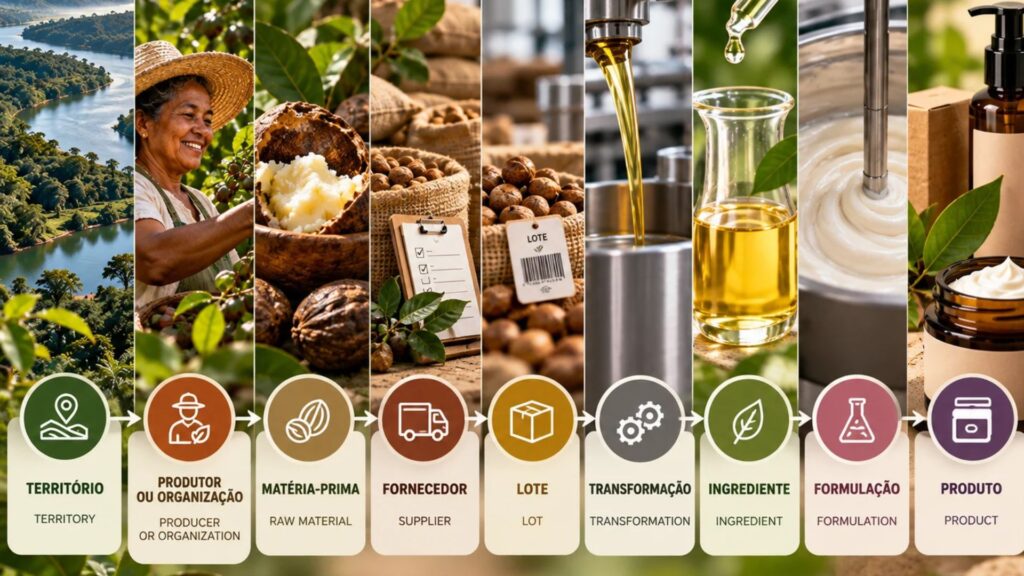
Not all of this information will necessarily be public. Not all of it will be available from day one. But its progressive organization creates something that a simple folder of documents cannot produce: informational continuity.
The SUIDChain website specifically treats natural cosmetics as one of its priority supply chains, tracking ingredients, suppliers, batches, geographic regions, and documentation. For natural products and ingredients, the initiative covers oils, extracts, fibers, seeds, and other raw materials—from their source through processing to commercial use.
Crafts: When Authorship and Conformity Must Coexist
In the world of handicrafts, there is yet another element: authorship. A handcrafted piece is not merely the result of raw materials. It involves technique, knowledge, culture, creativity, and human involvement. Therefore, its digital identity should not be constructed solely as a list of materials and documents. It must also preserve information about who produced it, where, using what technique, and within what geographical context.
This creates a significant difference compared to conventional industrial traceability. In industry, we often want to know: Which component went into which product?
In the field of crafts, we may need to answer the following questions simultaneously: What materials were used in this piece? Who made it? Where did it come from? What technique was used? And what evidence supports this information?
SUIDChain itself structures the crafts and creative economy in this way, linking authorship, techniques, materials, and territory to the product’s digital identity. For cooperatives, associations, and local projects, the platform also provides a way to organize producers, communities, raw materials, products, batches, documents, and territories.
The supplier’s declaration, therefore, does not disappear from this context. It simply changes context. At certain stages, there may be a formal, structured declaration. At others, the first challenge will simply be to build the capacity to identify the supplier and consistently record what the supplier declares about its material or process.
Home and Decor: One Product, Many Origins
A decorative piece illustrates how these supply chains can quickly become complex. Imagine a handcrafted lamp made from natural fiber, a metal frame, and a textile finish. There are at least three categories of materials, potentially three suppliers, different processes, and a handcrafted assembly stage. A basket may combine different fibers. A pillow may involve fabric, filling, thread, dyeing, and handcrafting. A piece of furniture may incorporate wood, fabric, hardware, and finishes.
The SUIDChain website lists Home & Decor among its main sectors and aims to connect materials, suppliers, production, batches, origin, and documentation.
Here’s an important point for small brands: you don’t have to start by tracking absolutely everything with the same level of detail. The platform’s architecture is designed to evolve from a single product to batches, collections, and entire supply chains, depending on the brand’s maturity and need for verification.
This is much more in line with the reality of small operations. Traceability is no longer a massive project that has to be perfect from the start; instead, it becomes a capability that can evolve over time.
Sociobiodiversity: When the Supplier Can Be an Organized Territory
In the bioeconomy and sociobiodiversity, the concept of a supplier can become even more complex. A raw material may be linked to a community, a cooperative, an association, or a group of producers. The product may hold value precisely because there is a relationship between biodiversity and territory.
In this scenario, reducing traceability to “Company A supplied raw material B” may omit essential details.
It may be necessary to structure relationships such as:
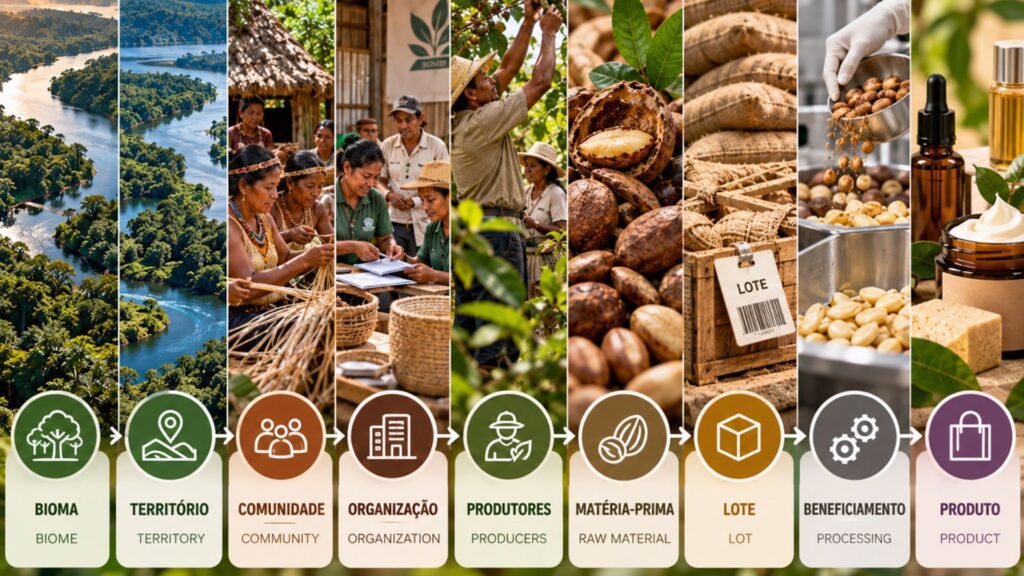
SUIDChain identifies the bioeconomy and socio-biodiversity as one of its areas of application precisely because of its ability to connect biodiversity, territories, communities, raw materials, and evidence.
It is in this type of supply chain that the declaration of conformity can cease to be merely a documentary requirement and instead raise a deeper question: How can we enhance the documentation capabilities of those at the base of production without erasing the characteristics of that base?
ISO/IEC 17050 as a reference, not as a shortcut
ISO/IEC 17050 can contribute to this discussion, but we must avoid drawing a dangerous conclusion: simply handing out a form to each small producer and asking them to sign it does not, in and of itself, create a trustworthy chain.
ISO/CASCO describes the Supplier’s Declaration of Conformity as a first-party attestation and emphasizes that it must identify, among other elements, the issuer, the subject of conformity, the declaration made, and the specified requirements to which conformity is being declared. Part 2 addresses supporting documentation and includes requirements related to the traceability, availability, and retention of such documentation.
Therefore, taking this reference seriously means precisely not turning the statement into a mere bureaucratic formality.
If an association specifies a certain characteristic of a fiber, we need to know which characteristic it is.
If a supplier declares a specific composition, we need to identify the item.
If a particular raw material meets a specification, we need to identify which specification it is.
If there are supporting documents, they must remain relevant to what they support.
Above all, a first-party declaration should not be presented to the market as if it were an independent certification. ISO itself advises against using the term “self-certification” to avoid this confusion.
From the impossible document to the possible evidence
Perhaps this is where the greatest opportunity lies for artisanal, natural, and bioeconomy products.
When we look at a large industry and then at a small local supply chain, we can conclude that the latter “lacks traceability” because it does not have the same documentation as the former.
But perhaps the right question is a different one:
What is the best evidence this chain can produce today—and how can we help it produce better evidence tomorrow?
This shift in perspective is important.
A georeferenced photograph is not a certificate.
An artisan registration is not an audit.
A supplier's declaration is not a third-party certification.
A batch record alone does not prove sustainability.
A QR code does not prove origin simply by existing.
But each of these elements can occupy a specific place within an evidence architecture, provided we know who generated the information, when, about what, and for what purpose.
Linked SUIDs: Allowing the Chain to Grow in Granularity
It is precisely in this context that the SUID Master + linked SUIDs architecture can take on special significance.
The final product may have its own primary identifier. Other elements in the supply chain may be linked to this identifier depending on the maturity of the operation: batch, raw material, collection, production stage, or other identifiers required by the implemented model.
An artisanal necklace could start like this:
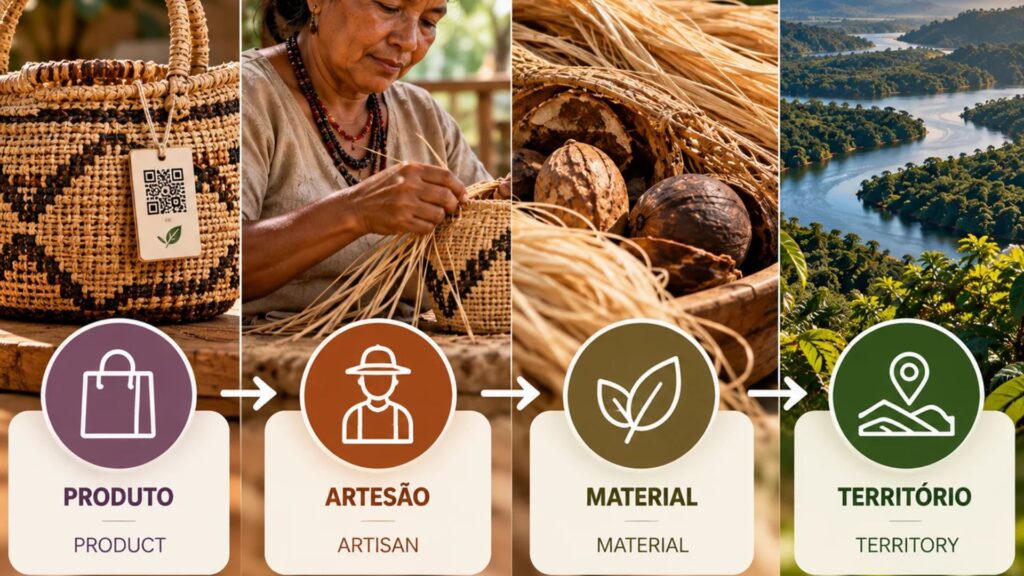
And grow into:
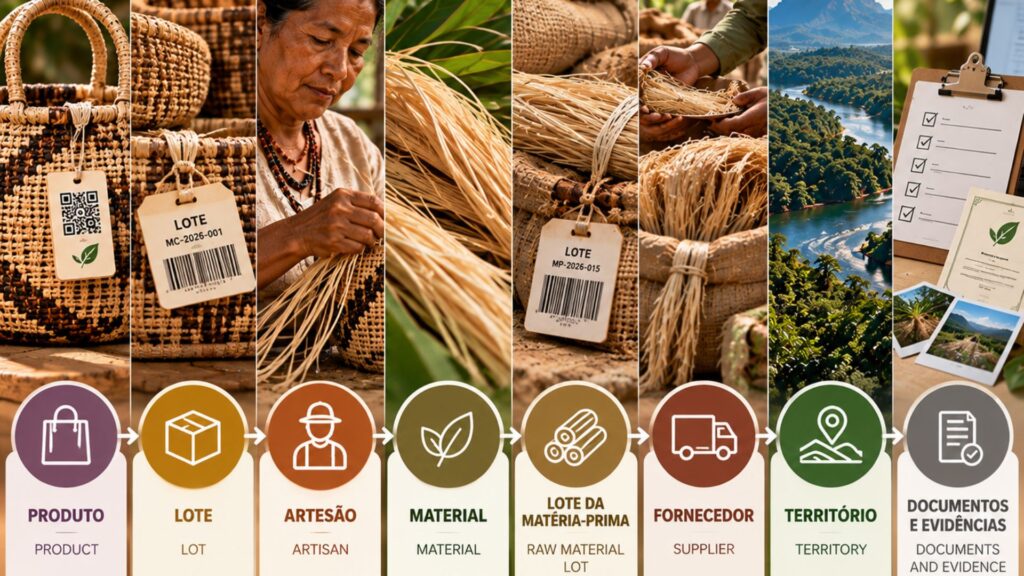
Technology does not create data that the supply chain has never collected. But it can prevent the data that has been collected from continuing to be lost.
SUIDPass and public consultation: when a small chain enters the market with a well-defined history
Once internal relationships have been established, there is still the question of what reaches the buyer.
Through SUIDPass, selected information can be accessed via the QR code associated with the product. Public access does not need to disclose contracts, confidential information, or the entire supply chain documentation. It can present only what is relevant: origin, authorship, territory, materials, techniques, process, selected evidence, and other information that the organization has decided to make available.
The SUIDChain website itself describes SUIDPass as follows: the QR code links the physical product to its digital identity and provides access to selected information about its origin, materials, production, documents, evidence, and history.
For handmade and natural products, this has a particularly interesting commercial aspect.
What previously existed only in the producer's words may begin to reach the market in a structured way.
Not to turn culture into a database.
Not to replace the voice of the creator.
But to prevent the product's origin, authorship, and territory from disappearing just as it begins to distance itself from its creator.
Compliance can begin before certification
There is an important idea behind all of this: artisanal, natural, and bioeconomy supply chains do not need to wait until they have the documentation infrastructure of a large industry to begin organizing their evidence.
You can start by acknowledging what you already know.
Who produces it?
Who is the supplier?
Where does it come from?
What material?
Which territory?
Which batch, if any?
Which process?
What document is there?
Who made that statement?
What does this statement actually say?
What evidence is there to support it?
And what haven't we been able to prove yet?
The last question may be one of the most important. Reliable traceability isn't the kind that pretends to have all the answers. It's the kind that can distinguish between what it knows, where it got that knowledge from, and what it still needs to figure out.
For artisanal, natural, and bioeconomy products, this capability can mean much more than just documentary compliance. It can be a way to preserve information that is normally lost as the product moves further away from its region of origin.
In this context, the supplier’s declaration of conformity is no longer just a document typical of mature industrial supply chains; instead, it prompts us to ask a bigger question:
How can we foster a culture of evidence even in work processes where knowledge exists but has not yet been transformed into structured documentation?
It is in this context that traceability, digital identity, and the Digital Product Passport can play a significant role.
Not turning the artisan's story into a commercial enterprise.
Not a substitute for certifications.
Not treating a statement as conclusive proof.
But by gradually building a bridge between the producers, their knowledge of the product, the evidence they can gather, and the market—which needs to understand where that product came from.