Documents, origin, and evidence: the challenge of traceability in the bioeconomy
There is a fairly common scenario in the artisanal, natural, and bioeconomy product sectors. A company asks about the origin of a particular raw material and receives a document. It asks about the supplier and finds a registration record. It looks for information about an artisan and discovers photographs, messages, and a form filled out months ago. It seeks proof regarding a certain material, and someone locates a PDF sent by email. It asks about the region, and there is a presentation telling the community’s story. In some cases, there are certificates, supplier statements, reports, invoices, receipts, photographs, association documents, and spreadsheets. There is information. There is documentation. There is memory. But when the decisive question arises— which of these pieces of evidence pertains exactly to the product before us? —the answer may no longer be so simple.
This is one of the less obvious problems with traceability. For a long time, digitizing documents was treated as synonymous with digitizing a chain. It is not. A PDF file is digital, but that does not mean the relationships it represents are also digitized. A photograph stored in the cloud remains a photograph. A declaration of conformity inside a folder remains a declaration. A spreadsheet listing suppliers remains a spreadsheet. A certificate still has its own scope. For this information to effectively contribute to traceability, we need to know who produced the information, what object it refers to, when it is valid, and how that object relates to the other elements in the chain.
When it comes to artisanal, natural, and bioeconomy products, this discussion takes on an even greater dimension because we are dealing with supply chains that often did not originate within structured industrial systems. A piece of bio-jewelry may begin with a seed collected or purchased in a particular region. A basket may be made from a natural fiber that passed through the hands of different people before reaching the artisan. A cosmetic product may combine oils, extracts, and butters from different suppliers. A decorative item may combine wood, fiber, fabric, and handcrafted work. A locally sourced food product may pass through producers, cooperatives, processing, and transformation. The story exists. The challenge is to prevent the evidence of that story from becoming disconnected fragments.
The problem isn't just the lack of documents
When we talk about traceability in small supply chains, it is common to assume that the main problem is simply a lack of documentation. In many cases, this is indeed true, especially in the early stages of less formalized supply chains. But there is a second, equally important challenge: documents may exist but still fail to form a chain of evidence.
Imagine a brand that works with artisans from different regions. It maintains records of producers, photographs of the pieces, purchase invoices, information about materials, and documents received from partner organizations. During an internal audit or in response to a buyer’s request, someone asks: Which pieces in the current collection were produced by Group A? What fiber was used? From which supplier did it come? When was it purchased? Is there any documentation associated with that raw material? Which currently available products were produced using that batch?
Answering these questions requires more than just having files.
It requires relationships.
You can think of this as a difference between a record and a structure. A record stores evidence. A structure indicates where that evidence fits. When we are able to connect the two, we begin to build traceability.
This difference is particularly important for the bioeconomy because a single organization may work simultaneously with dozens of small suppliers, natural raw materials, regions, communities, artisans, and processes. The greater the diversity of the supply chain, the greater the likelihood that relevant information will be lost over time.
A folder named “suppliers” does not represent a supply chain
Consider a digital folder called “Supplier Documents.” Inside it are twenty subfolders. Each one contains contracts, invoices, statements, photographs, and other records. From a documentation standpoint, this may represent a reasonable level of organization. From a traceability standpoint, however, fundamental questions remain unanswered.
What material did that supplier deliver?
When?
Is there proof of receipt?
Was there a draw?
In which products was this material used?
Does the document found pertain to all deliveries from that supplier, or only to a specific raw material, time period, or condition?
Does a statement received in January still apply to the material delivered in November?
Does the scope of the certificate presented match what we are associating with the product?
These questions demonstrate why the supplier cannot be the sole organizational unit for the evidence.
A single organization may supply different materials. A single material may arrive in multiple batches. Different documents may have different validity periods or scopes. A finished product may consist of materials from multiple suppliers. And a single batch of raw material may be used in multiple products.
The chain begins to take shape when we are able to maintain these relationships.
In the world of crafts, the document may be quite far removed from the piece itself
Imagine an association that brings together forty craftswomen. The organization has institutional documents and information about the region. Each craftswoman produces different types of pieces. Raw materials may come from the region itself, from external suppliers, or from different sources throughout the year. The pieces are grouped into collections and later marketed under a brand or project.
At some point, a photograph from the association begins to be used as proof of origin for all products.
It's understandable, but technically there's a significant difference between the two.
A photograph demonstrates the existence of a particular context. It does not necessarily prove that that specific piece was produced by a particular person or with a particular material. Similarly, a community’s registry does not, on its own, prove the origin of all the materials used by its members. A statement about a particular process does not necessarily mean that all products have undergone that process.
This does not diminish the value of this evidence. It simply shows that we need to understand what each piece of evidence actually supports.
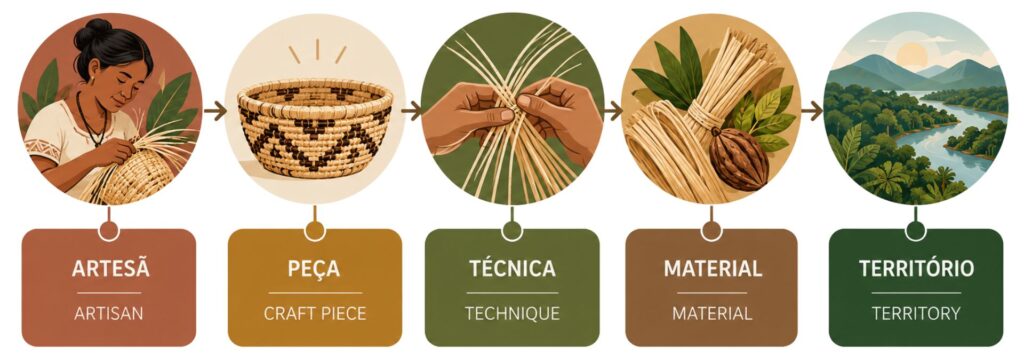
In handicrafts, a chain might begin with relatively simple relationships:
As maturity increases, other relationships can be incorporated:
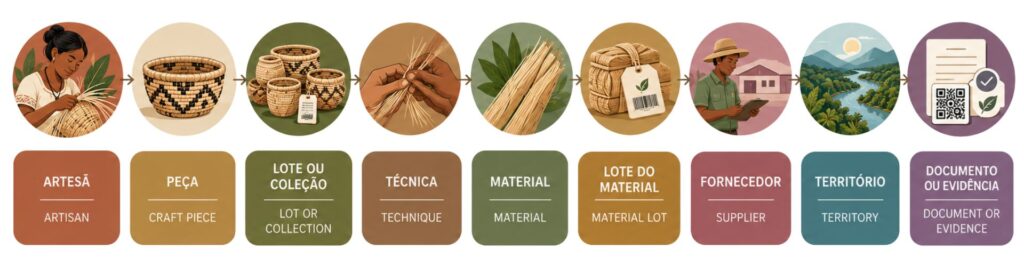
The important thing is not to artificially fill in the gaps. If a particular source level is not yet known, traceability should reflect that reality. Transparency also means knowing how to recognize the limits of what we can demonstrate.
A piece of biojewelry can carry various levels of evidence
Bio-jewelry offers a particularly interesting example because a small object can encapsulate a rather complex supply chain. A single piece may combine seeds, fibers, wood, metals, pigments, threads, and handcrafted work. The artisan may be clearly identified, while the origin of one of the seeds does not yet have the same level of detail. The metal may come from a commercial supplier. The fiber may originate from a cooperative. Each material has its own journey.
If all these elements are simply grouped under a single label such as “a product of Brazilian biodiversity,” some of the complexity is lost.
An evidence-based framework allows for more precise work. Some items may have an identified supplier and a known location. Others may have only a supplier. Still others may have additional documentation. The item’s provenance may be fully documented. The technique may be described. The item may be linked to a specific collection.
Traceability does not require that every link in the chain have exactly the same level of information.
It requires that we not present different levels as if they were the same.
This distinction is valuable because artisanal and bioeconomy products possess attributes that are often used commercially: origin, territory, biodiversity, manual labor, authorship, natural materials, and traditional knowledge. The greater the value attributed to these elements, the greater the care that should be taken to understand what evidence supports each claim.
Natural products: the ingredient may change, but its identity shouldn't disappear
The challenge becomes even more apparent when the raw material undergoes processing. A vegetable oil may start with a specific species and region, then go through harvesting or cultivation, processing, extraction, refinement, and distribution before becoming part of a formulation. A fiber may be harvested, prepared, dyed, and processed. A natural ingredient may be incorporated into different product batches.
Physically, the raw material changes.
From an informational standpoint, however, it would be desirable to preserve the relevant relationships.
This is where batch tracking becomes important. A batch should not be viewed merely as a number printed on the final product. It can serve as a link between different stages of processing.
A conceptual framework could be:
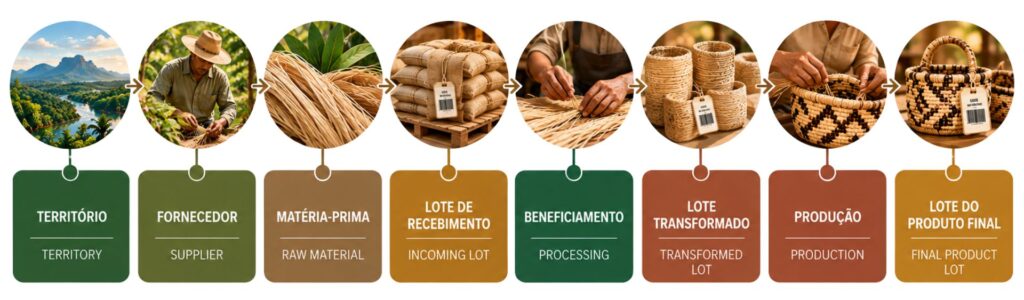
When these elements remain connected, a document ceases to be merely “a company file” and comes to occupy a specific position within the chain.
A document should not lose its identity
There is another fundamental principle: evidence must also have an identity.
- A certificate has an issuer, scope, number, dates, and its own rules.
- A statement has a declarer, an object, and stated content.
- A test report includes the sample, method, laboratory, date, and result.
- An invoice records a specific business transaction.
- A photograph captures a particular situation.
- A record stores information provided at a specific point in time.
- An official document has the authority and purpose assigned to it by the responsible agency.
When all these things are simply grouped under a button labeled “documents,” we miss an important opportunity to structure knowledge.
The question should not be merely “Which file should we attach to the product?” but rather “What is the nature of this evidence, and how does it relate to this product?”
This precaution also protects the supply chain itself. A small association may have issued a specific statement and later discover that it is being used commercially to support much broader claims. A certificate may have a limited scope but appear in communications as if it covered the entire operation. A territorial document may be associated with raw materials whose origin has not been effectively demonstrated.
Responsible traceability must prevent this type of undue expansion of the evidence.
From the file to SUID: structuring relationships
Storing documents does not necessarily mean establishing traceability. A statement may be in the supplier’s file, a photograph may document a specific production step, and an invoice may prove a purchase, but a fundamental question remains: How does this information relate to the product that reached the market?
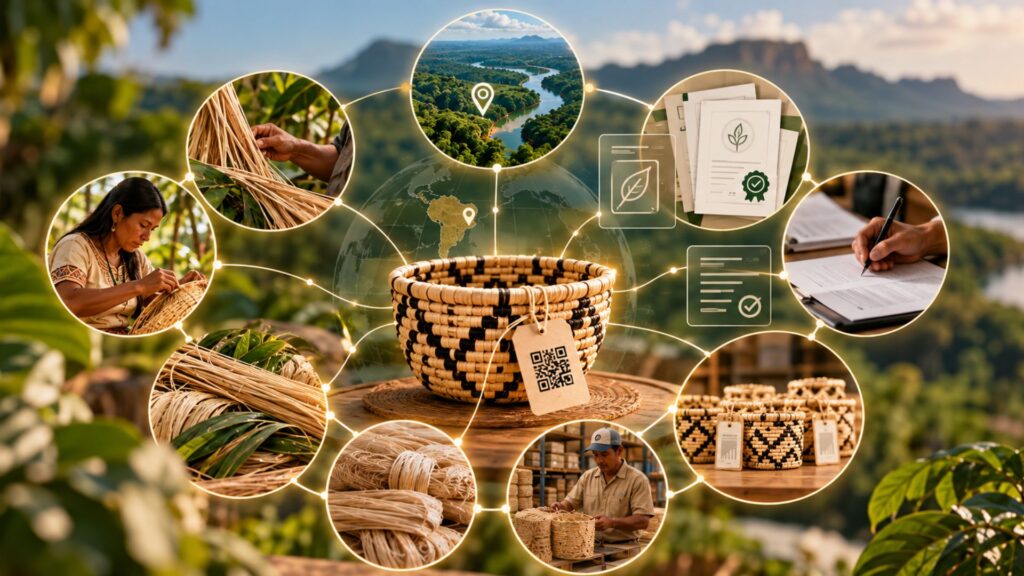
In the SUIDChain™ architecture, a product can have a primary digital identity—the SUID Master—to which SUIDs are linked as needed and based on the chain’s maturity. These links can represent batches, raw materials, production stages, collections, or other relevant elements. The goal is not to create more codes, but to preserve relationships that make it possible to trace the product’s journey.
In a handcrafted piece, for example, the structure can connect:
SUID Product Master → Production → Artisan → Material → Lot → Supplier → Territory → Record.
Thus, a statement is no longer just a stored file. It can be linked to the supplier that issued it, the material to which it refers, and, when applicable, the corresponding batch. That batch can be linked to production and, ultimately, to the product. The architecture helps us understand not only that a piece of evidence exists, but exactly what role it plays within the chain.
In a natural cosmetic product, the logic may take on a different form:
SUID Master → product batch → formulation → ingredient → ingredient batch → supplier → origin → document.
In a piece of bio-jewelry:
SUID Master → collection → artisan → seeds or fibers → suppliers → regions → evidence.
The framework can be adapted to natural foods and ingredients, handcrafted textiles, forest products, recycled materials, bioproducts, and other supply chains. There is no single architecture: an operation can begin by linking a few elements and expand its granularity as new data and evidence are structured.
It is this transition from the file to the record that makes the difference. A PDF remains a PDF, a statement remains a statement, and a photograph remains a visual record. What changes is the ability to identify which supplier, material, batch, stage, or product that information pertains to.
The principle is simple: information must remain linked to the element it describes.
A public consultation does not mean publishing all documents
Once internal relationships have been established, another question arises: what should be presented to the market?
The answer isn't “everything.”
The public view of a traceable product must be distinct from the internal evidence database. Some information may be commercially relevant to consumers and buyers: origin, region, authorship, materials, techniques, specific processes, manufacturer, characteristics, and selected evidence. Other information pertains to B2B relationships, auditing, compliance, or the company’s internal management.
Through SUIDPass, the physical product can serve as a gateway to this public layer. A QR code links to the corresponding identity and allows selected information to be viewed.
This distinction is fundamental. Transparency does not mean simply posting documents online. Transparency means ensuring that relevant information can be understood and that, when appropriate, it is possible to trace its source.
For a consumer, it may be enough to understand that a piece was produced by a specific artisan, in a specific region, using specific materials and techniques. For a B2B buyer, an additional level of detail may be necessary. For an audit, yet another. The identity may be the same. The levels of access and purpose are different.
When evidence also becomes commercial value
This architecture is beginning to have a direct impact on marketing. For artisanal, natural, and bioeconomy products, a significant portion of their value lies in attributes that cannot be perceived simply by looking at the object.
We can’t look at a basket and figure out who made it. We can’t look at a piece of organic jewelry and identify which region a particular seed came from. We can’t look at a cosmetic product and trace the origin of a vegetable oil. We can’t look at a handmade pillow and figure out the dyeing process.
These attributes exist, but they are invisible. Historically, marketing has made them visible through storytelling. Traceability can add a new layer: evidence. A story might say that a piece was made in a certain region. Digital identity can link the piece to the producer and the region.
A statement may claim that a certain item comes from a specific source. The data chain may indicate what information supports that claim.
The brand can showcase the craftsmanship. The public consultation can identify the artist and technique. This is where traceability begins to become a tangible marketing asset—not because a QR code is an advertising campaign, but because what once depended exclusively on narrative can now be supported by an information infrastructure.
From Narrative to Evidence
This may be one of the most interesting changes for brands in the bioeconomy. For a long time, communicating origin meant telling a story.
In the future, “increasingly” may come to mean telling a story and allowing certain elements of it to be accessed.
This does not diminish the importance of storytelling. On the contrary. Stories remain essential for connecting people, places, and products. What has changed is that storytelling no longer bears the entire burden of trust on its own.
There is a difference between writing: “This play highlights Brazilian knowledge and raw materials.”
and be able to organize the information as follows: who produced it → where → using what technique → using what material → supplied by whom → associated with what evidence.
The first sentence conveys information. The second structures knowledge. When the two work together, a The chain of evidence doesn't have to be perfect from the start
One of the biggest obstacles for small businesses, cooperatives, associations, and bioeconomy projects is the assumption that traceability only becomes valuable once 100% of the supply chain has been mapped. In practice, this expectation can actually prevent the very first step from being taken. An organization can start by identifying products and artisans, then incorporate materials and suppliers, move on to regions and batches, and gradually link declarations, documents, and other evidence.
The most important thing is not to fill in every field from the start, but to understand the level of granularity that exists at that moment and which relationships can actually be demonstrated. A supply chain that can clearly substantiate part of its information may be more reliable than one that claims to have complete traceability but cannot explain the origin of its own data.
This progressive approach also changes the way we view documents. Instead of simply asking where a statement, photograph, record, or certificate will be stored, the question becomes: To what exactly does this evidence pertain? Who produced it, what does it state, what is its scope, and to which supplier, material, batch, territory, or product can it be linked? It is also necessary to understand what that evidence can support—and, equally important, what it cannot prove. It is through these relationships that isolated documents begin to form a chain of evidence.
For artisanal, natural, and bioeconomy products, this shift is particularly relevant because much of a product’s value is created before it takes its final form: it lies in the land, in biodiversity, in the raw materials, in the hands that produce it, and in the knowledge applied to its processing. When these connections are not preserved, the product reaches the market, but part of its identity is lost along the way. Therefore, the next frontier of traceability may not lie in producing more and more documents, but in connecting existing evidence—and that which still needs to be established—to the people, materials, batches, territories, and products to which it actually belongs.
A folder can store documents. A database can store records. A QR code can open a webpage. But the chain truly begins to be reconstructed when we can answer the question: “To what does this evidence belong?”—potentially more consistent communication.