From Recovery to Transformation: How to Create a Chain of Evidence for Recycled Materials
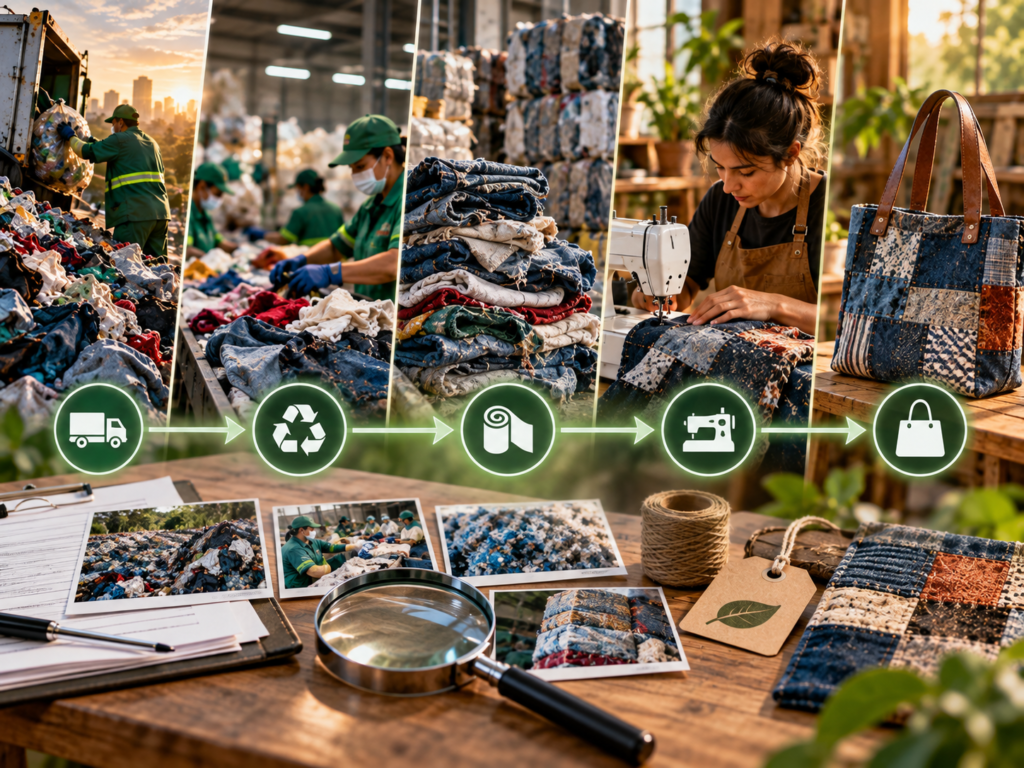
A handmade piece crafted from reclaimed materials can tell an extraordinary story. The fabric may have been saved from a stock that was destined for the trash, the wood may have come from another product, a canvas may have been used for years before being transformed into a bag, and small scraps may have been assembled through patchwork to create an entirely new piece. However, there is an important difference between having a story and being able to demonstrate the elements that support it. It is in this difference that the concept of a chain of evidence arises.
As sustainability and circularity gain prominence in commercial communications, the need to clarify claims made about products also increases. “Recycled,” “reused,” “made from waste,” “handcrafted,” “upcycled,” and “responsibly sourced” convey different characteristics. A chain of evidence helps link each claim to available information about materials, processes, people, and documents, bridging the gap between narrative and production reality.
The chain of evidence begins before production
Imagine a group of craftswomen who receive surplus fabric from a textile manufacturer. Even before the first scrap is cut, there is already potentially relevant information available: the supplier, the date of receipt, the type of material, the approximate weight or quantity, the condition of the fabric, and the associated documentation.
Then another stage begins. The materials are sorted, distributed, and used in different products. Some pieces may be made using patchwork, others may use larger pieces, and certain fabrics may be kept in stock for future collections.
If these transitions are not recorded, the organization will know that it works with reused materials, but will have difficulty later determining which materials were used in each production run.
A chain of evidence seeks to establish continuity among these events.
Not all evidence supports the same conclusion
One of the most common mistakes in the discussion of traceability is to treat all documents as if they had the same meaning. A photograph, a statement, an invoice, a batch record, a certification, and an audit are all different elements.
A photograph can visually illustrate a particular material or process, but not necessarily its complete origin. An invoice can verify a transaction, but not automatically all the environmental characteristics attributed to the material. A statement records what a particular party asserts. A certification has its own scope, criteria, and rules.
Organizing evidence also means preserving these differences.
This approach is important to prevent digital systems from creating a false sense of verification. Blockchain, QR codes, or any other technology does not make incorrect information—entered at the source—true. Technology can help preserve records and relationships; the quality of the evidence continues to depend on how that information was produced.
How to Apply This Logic to Patchwork
Traceability must work in the real world. In artisanal patchwork production, requiring the individual registration of hundreds of small scraps would likely make the process unfeasible. The design of the traceability system must take into account the scale and operational capacity of producers.
One possible solution is to work with incoming batches. Materials received from a specific supplier, source, or period can be grouped under a single identifier. The batch can include information such as declared origin, material type, date, photographs, approximate weight, and existing documents.
Subsequently, products or collections can be associated with these lots.
Thus, traceability does not promise a level of accuracy that the operation cannot provide, but it also does not completely lose touch with the source.
Upcycling: Documenting the Transformation
Upcycling offers an additional opportunity: to document the transformation from the original object to the new product.
A jacket can be turned into a bag. A piece of canvas can be turned into a backpack. A bottle can be turned into a lamp. Reclaimed wood can take on a new purpose.
Photos taken before the transformation, records of the process, identification of the person responsible, and information about additional materials can help document this change.
This documentation also has cultural value. It demonstrates the human intervention required to produce the new piece and highlights the knowledge involved.
In the arts and crafts, this aspect is especially important because the handiwork should not be overshadowed by the generic description “made from recycled materials.”
SUIDChain as an infrastructure for linking evidence
In SUIDChain™, the SUID functions as a digital identity capable of organizing information related to the product, origin, territory, authorship, materials, processes, lots, documents, and evidence.
This makes it possible to establish relationships between different components of the chain without implying that they all have the same level of verification.
SUIDPass serves as an access layer to this information. Through a QR code associated with the product, selected data can be presented to consumers, buyers, and other stakeholders.
A patchwork piece, for example, may provide information about the technique, the production group, the region, and the batches of materials used. An upcycled product may document the transformation of the original material. A collection may include documents or evidence relevant to the process.
From Individual Evidence to Intelligence
Once structured, this data can serve another purpose. SUID Intelligence allows you to link information from different products, supply chains, and markets, transforming individual records into a foundation for analysis.
An organization can track the volumes of specific recovered materials, identify which collections use each batch, monitor products associated with specific regions, and better understand its commercial presence.
This means that investing in data quality isn't just for external communication. It can also improve one's own understanding of the operation.
For a cooperative, it can help visualize material flows. For a brand, it can improve supply chain organization. For productive development programs, it can help understand the progress of participating groups.
Evidence and Market Access
When these products begin to enter international markets, the organization must deal with another layer of complexity. Each market may have different requirements regarding documentation, materials, safety, labeling, importation, or communication.
Having traceability does not automatically mean that these requirements are met.
For this reason, the SERX—SUIDChain Export Readiness Index—serves as a complementary tool, assessing aspects related to an organization’s readiness for internationalization. It helps distinguish between two issues that are often confused: having a product with a track record and proven results, and having an operation that is prepared to export it.
Both are important, but they address different problems.
Evidence captures what the market fails to see
When a consumer looks at a patchwork bag, they see colors, texture, craftsmanship, and design. They don’t automatically see the hours of work that went into it, the materials that were saved from being discarded, the origin of the scraps, the people involved in the production process, or the existing documentation.
Much of the value of the circular economy is not apparent in the final product.
The chain of evidence serves as a way to preserve some of that informational value.
It doesn't need to turn every artisan into an auditor or every product into a technical report. It needs to find a level of documentation that is compatible with the reality of the supply chain and, above all, clearly communicate what can actually be demonstrated.
Because, in the circular economy, it’s not enough for a material to simply have a second life.
The more we are able to preserve the evidence of how this second life was built, the better we will be able to understand, communicate, and learn from each transformation.