Recycled—but from where? Why verifying the origin of materials is becoming part of the circular economy
“Made from recycled materials.” “Made from reused materials.” “Sustainable product.” “Upcycled.” These phrases are appearing more and more on labels, marketplaces, packaging, catalogs, and e-commerce sites.
They help convey characteristics that may be relevant to buyers and consumers, but they also raise a fundamental question: Where did the material come from? The more circularity becomes a marketing attribute, the more important it becomes to distinguish between what is merely claimed and what can be backed by information and evidence about its origin.
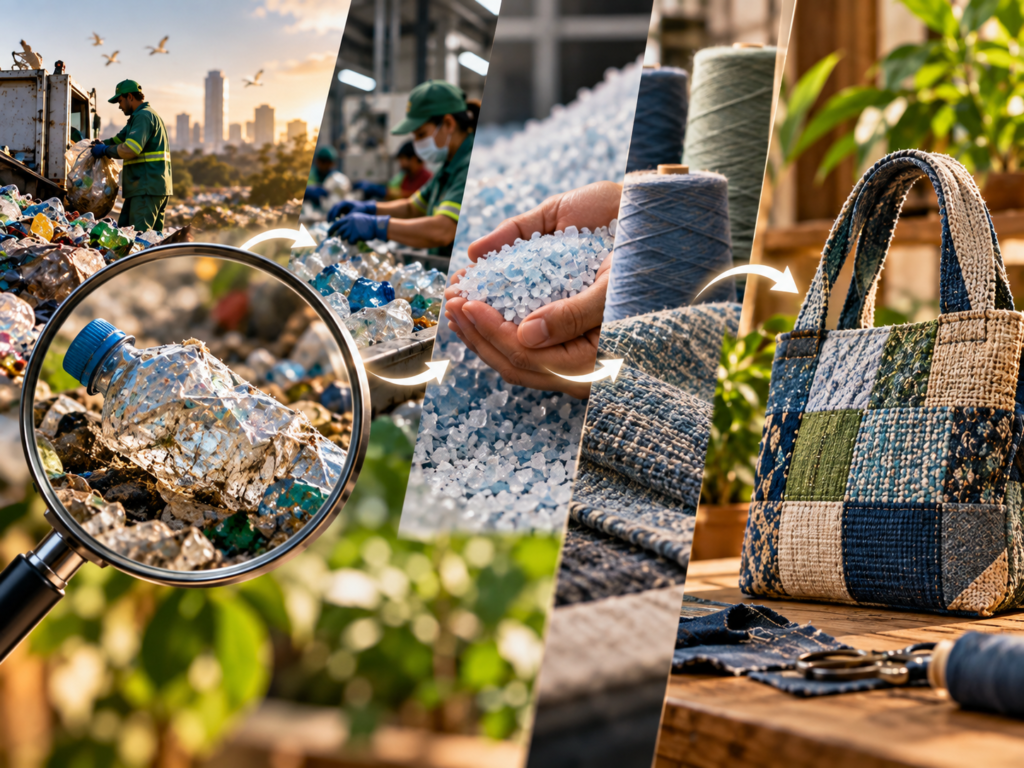
The question seems simple, but it reveals the complexity of circular supply chains. A fabric may come from scraps generated during industrial cutting, from production surpluses, from unused inventory, from a post-consumer item, or from materials that have already undergone recycling processes. In all these cases, there is some form of material continuity, but the pathways differ. If all of them are simply labeled as “recycled,” important information about the product is lost, and the risk of oversimplifying the sustainability narrative increases.
It all begins before the transformation
Consider a cooperative that receives fabric scraps from small garment manufacturers. The materials are sorted, organized, and distributed among artisans who produce bags, pillows, accessories, and decorative items. From that point on, what might be considered surplus becomes part of a new production chain. If the only record kept is the description “sustainable product made from scraps,” much of the economic and production history is lost.
Another option would be to record who supplied the materials, when they were received, what condition they were in, how they were classified, and in which production batch they were used. Traceability begins precisely with the ability to establish relationships between these events. It does not necessarily require knowing the entire history of each fiber, but it must make clear the extent to which the information is known and what evidence supports each claim.
This transparency regarding the limits of the information is just as important as the information itself. Saying that a particular material comes from surplus stock at a specific clothing manufacturer is different from claiming that all raw materials have a specific environmental origin or certification. A reliable infrastructure must avoid making sweeping generalizations.
Patchwork: When Many Fragments Form a New Identity
Patchwork helps us visualize this challenge in concrete terms. A quilt can bring together dozens of types of fabric, colors, patterns, and scraps. The technique itself is based on reassembly. However, it would be unrealistic to require a craftsperson to create an individual record for every scrap measuring just a few centimeters. Traceability must be proportional to the operational reality of the supply chain.
One alternative is to work with lots. Fabrics received from a specific supplier or during a specific period can be grouped together and identified. Photographs, approximate weight, type of material, declared origin, and available documents can be linked to the lot. Later, the finished products can be associated with the lots used.
This does not mean knowing the molecular origin of each fiber. It means creating a coherent information chain and clearly stating its level of accuracy. For artisanal chains, this approach can strike a balance between operational capacity and evidence-building.
Upcycling: Transforming Without Erasing the Past
Upcycling adds another dimension. In this process, existing materials or objects are transformed to take on a new function or form, often while preserving some of their original characteristics. A pair of jeans can be turned into a bag; a piece of canvas can become a backpack; a bottle can be turned into a decorative object; and pieces of wood can be reassembled into furniture.
The material’s history may in fact be one of the key differentiators of the new product. Documenting the transformation allows us to show not only the result, but also the transition from one function to another. Photographs of the previous material, batch identification, process records, and attribution can create an evidence-based narrative, rather than relying solely on a promotional claim.
For handicrafts, this possibility is particularly relevant because much of the value lies in human intervention. It is not just a matter of reclaimed materials; it is also about the knowledge applied to their transformation.
Verification does not necessarily mean certification
When discussing proof of origin, people often immediately think of a certificate. Certifications can play an important role in various supply chains, but they are not synonymous with traceability. Traceability functions as an infrastructure that connects information and events. Certifications, audits, declarations of conformity, supplier documents, batch records, and photographs can all be different elements within this structure.
This distinction is important because each piece of evidence answers a different question. An invoice can demonstrate a business relationship. A statement can record information provided by the producer. A photograph can visually document a specific step. A certification can attest to specific criteria within its scope. None of them should be presented as something they are not.
Building trust depends less on collecting stamps and more on properly organizing what each piece of evidence can demonstrate.
SUIDChain: Connecting Products, Materials, and Evidence
In SUIDChain™, digital identity can organize these different layers. A SUID can link products, materials, territory, authorship, processes, batches, documents, and evidence. In circular chains, this makes it possible to establish relationships between what entered the production process and what came out of it.
SUIDPass provides a way to access information via a QR code. A handcrafted bag made from repurposed materials, for example, can display information about its production, technique, creator, region, and the documented origin of the materials. The level of information provided may vary depending on the nature of the product, the available evidence, and the audience making the inquiry.
The most important thing is that technology does not invent evidence. It organizes what actually exists.
From Records to Intelligence
When this data is no longer isolated, it can yield new insights. SUID Intelligence adds an analytical layer to the structured information on the platform, making it possible to correlate data on products, cycles, market presence, and market signals.
An organization can begin to understand which materials appear in certain collections, which production groups use different techniques, which products reach specific channels, and how its market presence evolves. This transforms traceability into an infrastructure that can also inform business decisions.
For small-scale producers, this data can reveal patterns that were previously invisible. For organizations with broader supply chains, it can help consolidate information that is scattered among different stakeholders.
From Local Origins to the International Market
Handcrafted, patchwork, and upcycled products can also reach international buyers, but the story behind them does not eliminate the commercial requirements of exporting. It is necessary to evaluate documentation, logistics, production capacity, product classification, communication, distribution channels, and specific destination requirements.
SERX—the SUIDChain Export Readiness Index—plays a role at this stage by helping organizations better understand their readiness for international expansion. The goal is to avoid a common mistake: believing that a unique or sustainable product is automatically ready to compete internationally.
Origin can set a product apart. Evidence can build trust. But access to markets requires infrastructure.
“Recycled” is the starting point
Perhaps the evolution of the circular economy depends on our moving beyond general statements to more specific questions. Instead of simply asking, “Is it recycled?”, we can ask: What is its origin? Is the material post-industrial or post-consumer? Was it recycled, reused, or repurposed? Who carried out the recovery? How did the transformation take place? What evidence is there? Who created the new product?
These questions do not undermine the narrative of circularity. On the contrary, they make that narrative more mature.
When it comes to crafts and upcycling, there is yet another dimension: they help highlight the human labor involved between potential waste and a new product. A material does not transform on its own. There are people, techniques, places, and production decisions along the way.
When we’re able to connect these pieces of information, “made from recycled material” is no longer the end of the story.
This is just the beginning.