From the apiary to the jar: traceability and batch tracking for artisanal honey
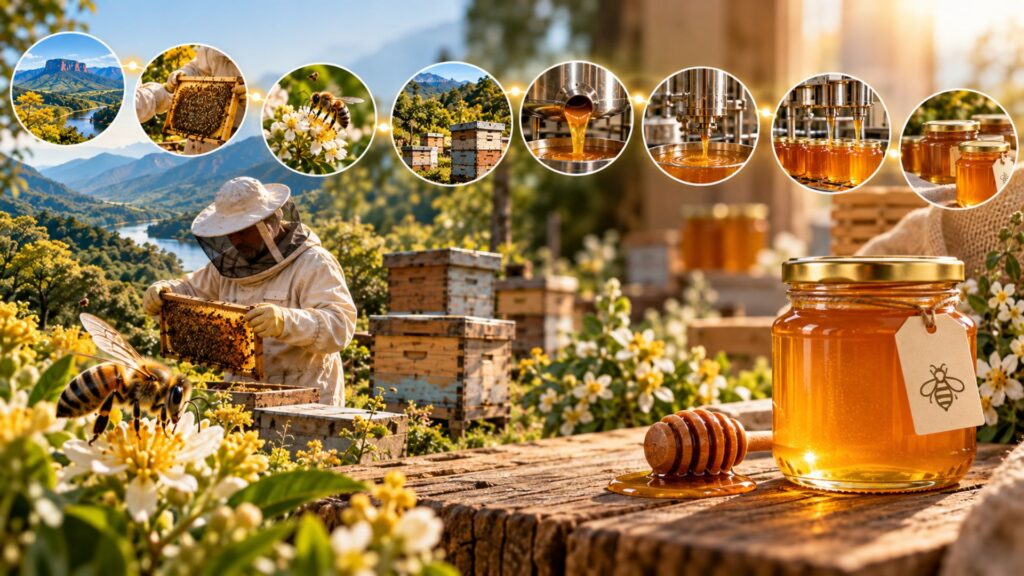
When we think of a jar of artisanal honey, it’s natural for our first thought to be of the final product: its color, texture, aroma, flavor, and origin as stated on the label. But before it reaches the jar, that honey has traveled a much longer journey. There is a specific region, vegetation, an apiary, hives, bees, a production period, a beekeeper responsible for management, and a sequence of steps that may involve collection, extraction, processing, storage, bottling, and marketing. Depending on the production structure, associations, cooperatives, processing facilities, and other stakeholders may also be involved. It is precisely along this journey that batch tracking can evolve from being merely a control mechanism into a system capable of preserving important information about the product’s history.
In artisanal, natural, and bioeconomy supply chains, this issue takes on particular importance because production is deeply tied to the local area and the conditions of each production cycle. Honey produced during a given period is not simply an indistinct unit that can be disconnected from its origin.
Production may be linked to a specific apiary, a particular region, a harvesting period, and a specific sequence of steps leading up to bottling. When these connections are not preserved, the product continues to move physically through the supply chain, but some of the information that could help reconstruct its journey is lost along the way. In this context, the batch does not represent the product’s entire history: it serves as one of the links that make it possible to reconstruct it.
From the apiary to the jar: the batch as a link in the production chain
Imagine a small-scale honey producer who works with different hives or apiaries. At a certain point, a harvest is collected and sent for extraction. The honey obtained may then be stored and later bottled into dozens or hundreds of jars. If identification occurs only at the end—when the products are assigned a lot number—it will be possible to identify that set of packages, but it may be much more difficult to trace the previous steps. Which harvest did that honey come from? When was it harvested? Which producer or organization was involved? What was the extraction process? Were there any records or documents related to that harvest? It is precisely this continuity that distinguishes simply having a batch from effectively tracking a batch.
A traceability framework could establish relationships such as:
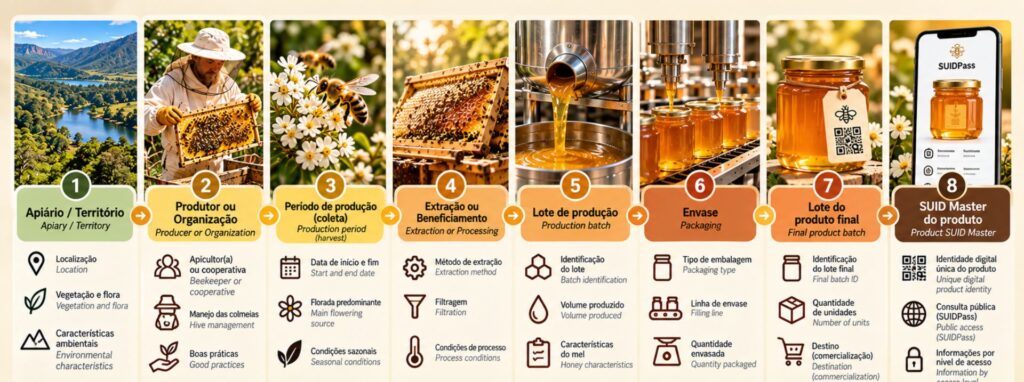
This architecture does not need to be identical for all producers. A family beekeeper who handles virtually the entire process may need a relatively simple structure. An association or cooperative that receives honey from different beekeepers may require greater granularity to record receipts, producers, time periods, and processing stages. The principle is not to create unnecessary complexity, but to identify which differences need to remain distinguishable after the honey enters the next stages of the supply chain.
This distinction becomes even more important when different batches are combined. If a cooperative receives honey from several beekeepers, for example, traceability must be able to reflect this reality without creating an artificially simplified origin.
A final batch may be linked to different receiving batches, just as a given receiving batch may be part of different production runs. The supply chain is no longer a simple line but rather a network of relationships. The more clearly these relationships are preserved, the greater the ability to trace information in both directions: starting from the final product and investigating its previous path, or starting from a given production run and identifying which products were generated from it.
In the case of honey, there is another particularly interesting characteristic: the territory is part of the production context. Vegetation, the production period, the apiary’s location, and other information can help contextualize that production, provided they are recorded and communicated responsibly. Traceability does not mean automatically turning this information into claims of quality, sustainability, or certification. It means preserving what is actually known and keeping this information linked to the product to which it pertains.
From the batch to the SUID: linking production, documents, and evidence
Tracking lots becomes more important when the lot number is no longer considered in isolation but is linked to other information. A production run may include records about the producer, the region, the harvest period, and the steps taken. A specific batch may have associated documents, receipt records, photographs, statements, analyses, or other evidence. If these elements are stored separately, the information exists, but it can be difficult to understand exactly which product, production run, or batch each piece of evidence belongs to.
In the SUIDChain™ architecture, this continuity can be structured using the SUID Master—which represents the product’s primary digital identity—combined with linked SUIDs to represent lots, stages, or other relevant elements of the supply chain. The goal is not to assign an identifier to everything simply because the technology allows it, but to create the necessary granularity so that important relationships remain connected.
In artisanal honey production, a facility might be set up as follows:
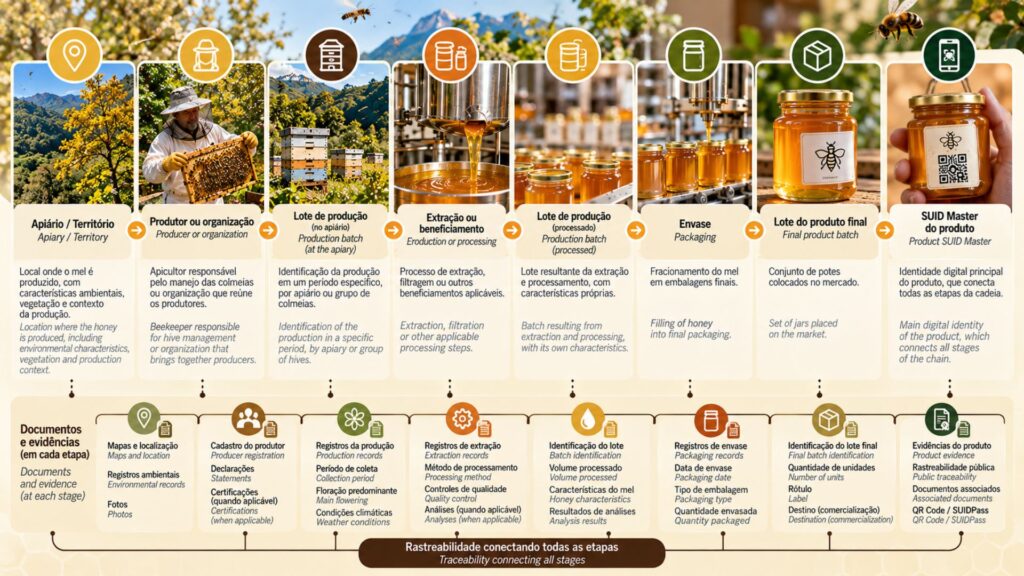
Thus, the container that reaches the market has a primary identity, but that identity may remain linked to the production process from which it originated. An analysis of a specific batch can be associated specifically with that batch. A statement may remain linked to the organization that issued it and to the object to which it refers.
A production record can document a specific step. Photographs or other records can supplement the chain of custody when relevant. The value lies not simply in accumulating documents, but in being able to identify which evidence relates to which element of the product’s journey.
This distinction also prevents misinterpretations. A statement remains a statement; an analysis remains limited to the object being analyzed; a photograph captures a specific moment; and a certification, when it exists, has its own scope. Digital identity does not transform evidence into something it is not. Its function is to help preserve the relationship between information, batch, stage, and product, creating a more structured chain of evidence.
For small-scale beekeepers, associations, and cooperatives, this process can take place gradually. It is not necessary to start by trying to digitize every detail of the operation. A producer can begin by linking the product, batch, and person responsible for production; then incorporate the location and time period; and later add stages, documents, and evidence. A cooperative can move toward a more detailed structure, distinguishing between producers, receipts, processing lots, and final products. The maturity of traceability lies not simply in the quantity of data recorded, but in the quality of the relationships that can be demonstrated.
When the batch also helps tell the story of the honey
There is also an important commercial aspect. When some of the structured information accompanies the product to the market, traceability ceases to be exclusively an internal tool. Through SUIDPass, a public query can display selected information about the product, producer or organization, territory, process, and other relevant attributes, while sensitive documents, operational information, and data intended for management remain at appropriate access levels.
Consumers don’t need to see the entire infrastructure behind a jar of honey. They don’t need to access internal spreadsheets or understand every code used in production. The public experience can be much simpler. By accessing the product’s digital identity, consumers can find information that provides context about its origin and production. Behind this interface, however, there may be a more complex structure connecting the product, batch, production, producer, region, documents, and evidence.
This possibility is particularly interesting for artisanal and bioeconomy products because much of their value is tied to characteristics that cannot be perceived simply by looking at the packaging. Two jars of honey may look similar on the shelf, yet represent very different trajectories: different producers, different regions, specific time periods, and unique production structures. Traceability should not be used to automatically claim that one of them is better, more sustainable, or of higher quality. It can, however, bring to light information that was previously confined within the supply chain.
This is where traceability and communication can converge. A brand’s narrative can address origin, producer, and process; traceability can help structure the information that underpins that narrative. The batch doesn’t need to take center stage for the consumer. Its value may lie precisely behind the scenes, allowing the organization to understand why certain information is being associated with that product and where it came from.
The boundaries of this relationship must remain clear. A lot number does not prove origin. A QR code does not prove sustainability. A digital identity does not replace documents or evidence. The value lies in the ability to connect what actually exists: who produced it, where a particular step took place, which lot is being identified, what records are available, and to which products this information pertains.
For beekeeping and artisanal honey production, this approach allows for the establishment of traceability in a way that is proportionate to the realities of small-scale producers, associations, and cooperatives. It is not necessary to transform an artisanal apiary into a large-scale operation to begin organizing its information. It is possible to start with just a few elements, preserve what is already known, and increase the level of detail as the supply chain matures.
Ultimately, the jar of honey represents only the final visible stage of a much longer journey. Before it came the land, biodiversity, bees, the apiary, the beekeeper, management, production, extraction, batches, bottling, documentation, and evidence. Tracking batches means creating the conditions to ensure that these connections are not lost when the product reaches the market.
Because honey can leave the hive, go through the extraction process, be bottled, and end up thousands of kilometers away from its place of origin . Its story doesn’t have to be left behind.