How to Highlight the Value Generated Throughout the Entire Supply Chain
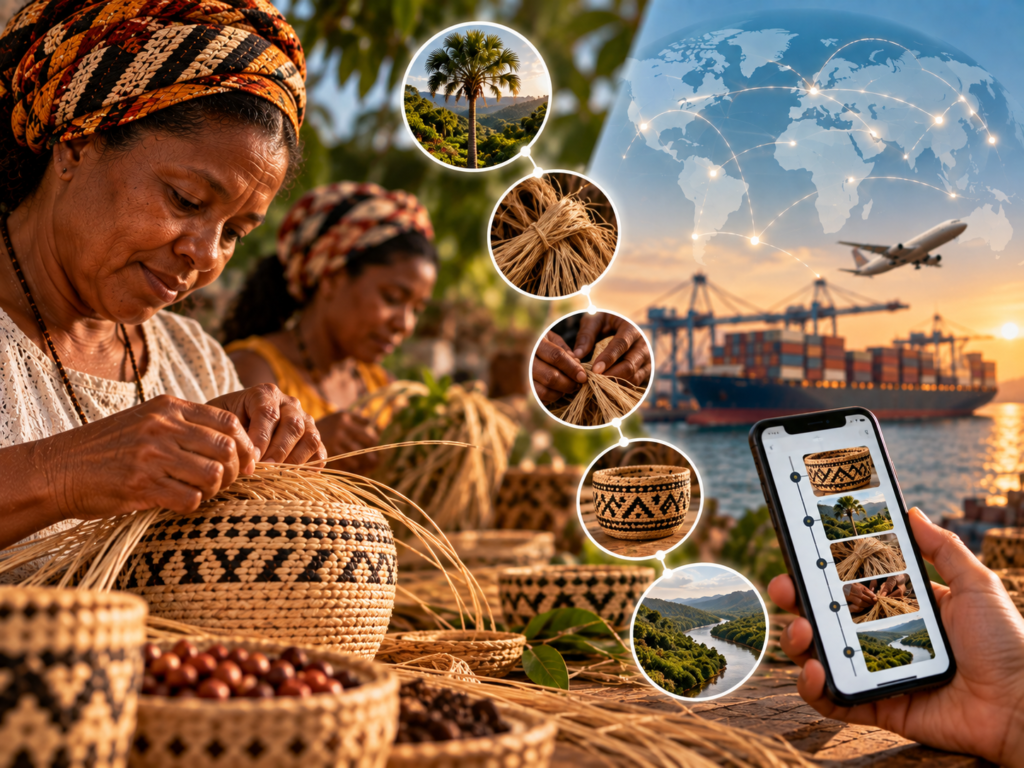
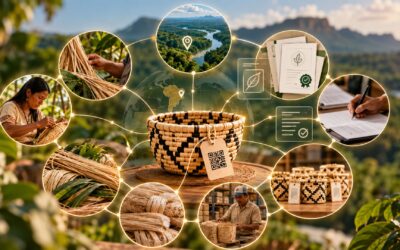
A product rarely begins where we usually see it. A basket does not begin as a basket. Fabric does not begin on the loom. A piece of furniture does not begin in the factory. Before the object exists, there is raw material; before the raw material reaches the hands of those who transform it, there is a region; before it reaches the market, there are people who gather, cultivate, select, prepare, transport, organize, and understand.
When the product finally appears before the consumer, this entire sequence is condensed into a single finished form. The object becomes visible, and the chain disappears. Perhaps one of the greatest potentials of traceability is precisely to reverse this logic: to allow us, when looking at a product, to also see the network of relationships that exists within it.
Think of a natural fiber that has been transformed into a handcrafted item. Before anyone can begin weaving it, there must be an environment where it grows, someone who understands that environment, the right time to harvest it, the method of preparation, and the characteristics that will determine its use.
Then there may be farming families, associations, cooperatives, designers, small businesses, logistics providers, exporters, importers, online marketplaces, and retailers. Each participant contributes something: knowledge, processing, organization, access, logistics, or market reach. However, the farther the product travels, the greater the risk that all this complexity will be reduced to the company name that appears on the packaging.
This happens because our traditional information structures were designed primarily to track goods, not necessarily to represent relationships. We know the SKU, weight, dimensions, quantity, inventory, and location. This data is indispensable for commerce. But it says little about the production architecture behind each item. When we add origin, region, suppliers, processes, materials, batches, participating organizations, and evidence, we begin to build a different representation. The supply chain ceases to be an abstraction presented in corporate diagrams and begins to emerge within the product’s very identity.
This visibility can also change our understanding of where value is generated. In many supply chains, the stages closest to the market have greater communication capacity and, consequently, greater visibility. Consumers are familiar with the brand and the retailer. They may know the country of origin. They rarely know who supplied the raw materials or who performed a specific processing step. This does not mean that one stage is more important than another. It means that some stages have a much greater ability to communicate their role in the process. Traceability can help partially rebalance this information asymmetry by recording who participated in the product’s journey and how.
But making a supply chain visible requires care. It’s not enough to simply accumulate data. A spreadsheet with hundreds of suppliers isn’t necessarily supply chain intelligence. Photos scattered across cell phones do not, in and of themselves, constitute organized evidence. Documents stored in separate folders may exist without ever being linked to the corresponding product. The key issue lies in the relationships between pieces of information.
Which raw material belongs to which batch? Which producer was involved in a particular stage? Which document supports a particular statement? Which region is associated with a particular product? When the dots begin to connect, traceability ceases to be a mere repository of records and instead represents a journey.
This process can yield insights. An organization may realize that a particular technique is concentrated among a few families. It may discover that a raw material depends on a specific region. It can identify gaps in documentation before initiating an export. It can understand which products have longer or more vulnerable supply chains. It can identify which regions contribute most to its portfolio. It can track commercial presence and understand where products originating in a specific territory are ending up. Traceability, then, does not just look back. It begins to help interpret the present and prepare for future decisions.
There is also an important opportunity: allowing information to flow back to its source. Digital supply chains can reproduce the same asymmetries as physical supply chains if all data flows upward toward companies and no insights flow back to producers. An artisan may provide information about their production without ever knowing in which markets their work is being sold. A cooperative may feed data into systems without receiving metrics that would help its own management. If we are to talk about adding value to the supply chain, this reciprocity must be part of the discussion. Market data, when appropriate and shareable, can also serve as tools for strengthening production.
Visibility must also respect certain limits. Not all supply chain information should be made public. Certain data may be commercially sensitive; other data may involve traditional knowledge or information that communities do not wish to disclose. Responsible transparency does not mean making everything available to everyone. It means establishing governance: defining who records, who validates, who accesses, and under what circumstances certain information may be shared. This distinction is essential to ensure that traceability does not become digital knowledge extraction.
When well-constructed, however, a product’s digital identity can function as a kind of thread that runs through the chain. The material is connected to its origin. The origin to the territory. The territory to the people. The people to the process. The process to the batch. The batch to the product. The product to marketing. And marketing can, in turn, generate new information about the market and the product lifecycle. What once appeared as a fragmented sequence begins to form a coherent story.
This change also has symbolic significance. For a long time, the value of countless supply chains was calculated backward: we started with the final price and tried to break down the costs. Perhaps we also need to learn to calculate forward: start with the source and look at everything that was added along the way until it reached the market. This perspective doesn’t eliminate price, margin, or efficiency. It simply adds a question that is usually overlooked: who and what made this product possible?
When we’re able to answer that question with structured information and evidence, the product ceases to be merely the final link in a chain. It becomes a window into the entire supply chain. And perhaps it is precisely this shift in perspective that allows us to recognize something that has always been right in front of us: value isn’t created when the product arrives at the store. It was built long before that, by many people, in many places, along a journey that deserves to remain visible.