Traceability as a Means of Adding Value to Handcrafted Products
A price tag can tell you how much a product costs, but it can hardly convey how much goes into it. The price can be summed up in a few numbers. The story cannot. Between the raw material and the finished object, there may be hours of work, choices, trials, accumulated knowledge, techniques learned from others, connections to the local area, and a series of small decisions that no photograph can fully capture.
Even so, when products hit the market, it’s common for all that complexity to be boiled down to a seemingly objective comparison: this one costs more, that one costs less. For artisanal products, this oversimplification can be especially unfair, because much of what sets them apart lies precisely in what the price cannot explain.
E-commerce has made price comparison extraordinarily efficient. In just a few seconds, a consumer can view dozens of products, sort results by price, and look at images that, on a small screen, appear almost identical. For certain categories, this efficiency is excellent. For others, it creates a paradox.
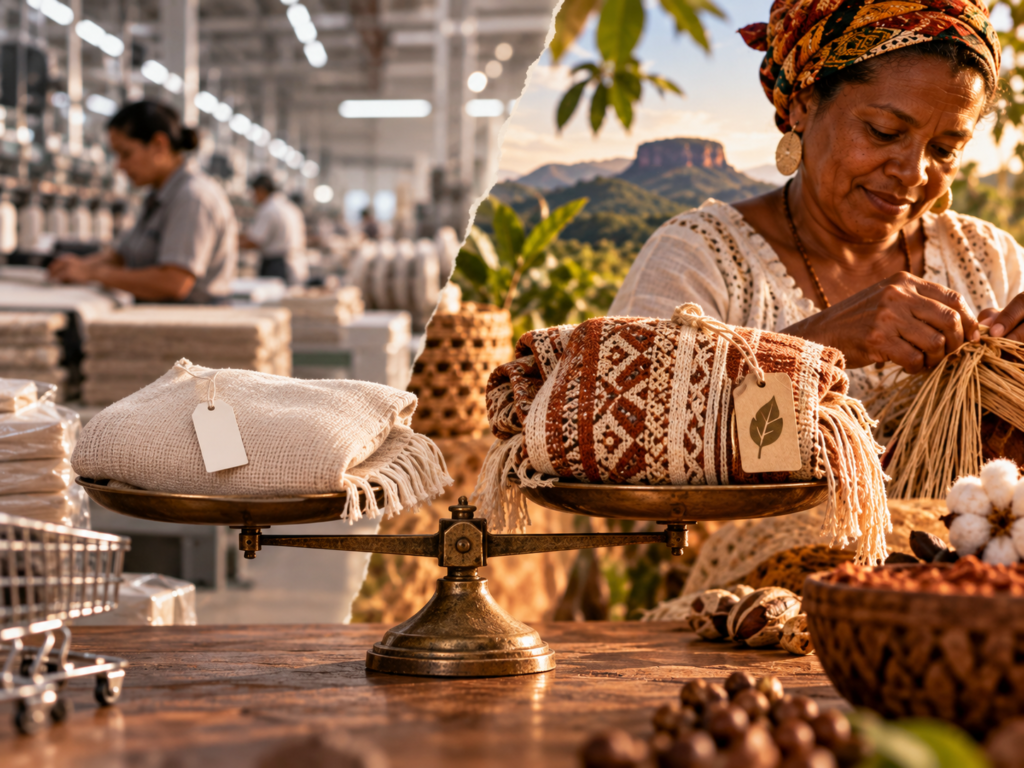
The easier it is to compare visually similar objects, the harder it can become to discern differences in their supply chains. An industrial part produced in the thousands may appear alongside a piece handmade by a small community. The two may have similar dimensions, similar colors, and equivalent functions. If the buyer is provided only with a photograph, material, size, and price, the logic behind the comparison is predictable: why pay more?
The answer shouldn't depend on romanticization. Handcrafted items aren't automatically better just because they're handcrafted, just as mass-produced items aren't automatically inferior just because they're mass-produced. Both can produce excellent or poor-quality items. The issue is a different one: they are different processes, and people need to be able to understand these differences.
One piece may require hours of manual labor. Another may depend on a technique that took years to master. A raw material may come from a specific region and require careful handling. A production process may support a local network of families. When these attributes are stripped away from the commercial experience, the market loses information that is relevant to determining how much value to assign to what it is purchasing.
This is where traceability and value creation begin to converge. Traceability should not be confused with an automatic justification for charging more. It works best as an infrastructure capable of demonstrating why two seemingly similar products may not be equivalent.
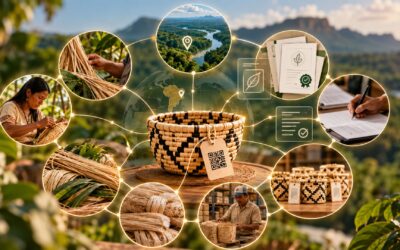
By linking authorship, origin, territory, materials, processes, and evidence to the product, it becomes possible to add context to the comparison. The buyer no longer sees just two baskets, two pieces of pottery, two fabrics, or two decorative objects. Instead, they are able to understand that there are different production trajectories behind each one.
This context is particularly important because perceived value is not determined solely by physical characteristics. Luxury brands have understood this for a long time. Design, provenance, authorship, limited editions, history, and reputation all play a role in building value across various categories.
The same reasoning can be applied—with due caution—to artisanal and regional products. There is a heritage of knowledge and identity that is often present in the product itself but absent from its commercial representation. The difference is that, in many cases, the goal is not to artificially create exclusivity, but rather to prevent genuine characteristics from disappearing when the product enters a distribution chain.
The information must also be reliable. As terms such as “handmade,” “sustainable,” “traditional,” “local,” and “responsible” gain commercial value, there is a growing incentive to use them as marketing language. This makes the distinction between claims and evidence all the more important.
A good story can spark interest; a traceability framework can help demonstrate where that story came from. Who produced it? Where? What materials were used? Is there a record of the process? Is there an associated organization? Was the information declared by the producer, validated by a third party, or supported by documentation? Not all answers need to have the same level of verification, but making it clear where the data comes from improves the quality of the available information.
There is also an ethical dimension to this discussion. Handcrafted products are often sold using images of communities, territories, and traditions as elements of commercial differentiation. However, if the people who sustain this narrative remain invisible within the economic chain, there is a contradiction.
The source becomes valuable for communication, but not necessarily for those at the source. Traceability alone does not resolve this inequality, but it can help reveal the structure of the supply chain. Who was involved? Who supplied the product? Who processed it? Who sold it? When these participants begin to be identified, it becomes more difficult to treat the story merely as marketing fluff.
At the same time, we must avoid the opposite extreme: turning the artisan into a character in a narrative of vulnerability. Valuing someone does not mean exploiting poverty, hardship, or exoticization to justify a price. An artisan’s knowledge must be recognized as a skill. A cooperative is a productive organization.
A traditional technique is knowledge. A community is made up of economic, cultural, and social actors, not backdrops for advertising campaigns. When used properly, traceability can contribute to this shift in perspective, because it shifts the focus from a romanticized image to concrete information about authorship, technique, process, and participation in the supply chain.
For international buyers, this layer of information can serve additional purposes. Origin, materials, documentation, and the supply chain may be relevant not only for communication but also for due diligence, commercial requirements, responsible procurement policies, and preparation for specific markets.
What began as a product story can, therefore, become part of a trust infrastructure. This is particularly important in markets where buyers and producers will never meet in person. The greater the physical, cultural, and commercial distance between the two ends, the greater the importance of mechanisms capable of preserving context.
Perhaps this is traceability’s most interesting contribution to the appreciation of artisanal products. It does not determine how much something should cost. It does not replace a business strategy. It does not guarantee demand. But it bridges the gap between the object that reaches the market and the supply chain that made it possible. It gives the buyer more information to make a decision and the producer more opportunities to be recognized for attributes that normally go unnoticed. The comparison is no longer made exclusively between objects but also between verifiable production stories.
In the end, price will remain just a number. And it will continue to be a deciding factor in many purchases. But a market that sees only price sees very little of what actually creates value. There are hands that the number doesn’t show, territories that don’t fit on a label, knowledge that doesn’t appear in a photograph, and time that cannot be measured solely by the cost of raw materials. Traceability doesn’t need to turn these dimensions into a spectacle. It simply needs to help them remain connected to the product. Because sometimes the difference between a generic commodity and a product recognized for its identity isn’t in what has been added to it. It’s simply in what hasn’t been erased.