Small-scale wholesale, large markets: traceability as a commercial passport for small producers and brands

When we think of international trade, it’s still common to picture large importers, full containers, orders for thousands of units, and suppliers with enormous production capacity. E-commerce is changing that image. Boutiques, concept stores, hotels, restaurants, specialty shops, small importers, designers, architects, and independent retailers are able to search for suppliers in different countries and place relatively small orders.
B2B platforms and small-scale wholesale models have created a gateway for companies and producers that might never have had the scale to participate in traditional international distribution models. For artisans, independent brands, and businesses linked to the bioeconomy, this transformation can mean access to buyers who value precisely what does not depend on mass production.
However, reducing the minimum order size does not automatically reduce the need for trust. A buyer who orders fifty pieces may be putting a significant portion of a small boutique’s budget at risk. A hotel needs to understand what it is incorporating into its spaces. A concept store builds its reputation through the curation of the products it selects. The more specialized the buyer is, the greater their interest may be in understanding the origin, materials, production capacity, restocking conditions, and evidence related to what they are purchasing. The MOQ decreases, but the need for information remains.
Small producers may have great qualities but lack an information infrastructure
This is one of the main challenges for small production chains. A producer may have mastered a traditional technique, work with raw materials specific to a particular region, have a production history spanning decades, and deliver a highly distinctive product. Even so, their information may be completely scattered. Some of it exists in physical documents, some is stored in the producers’ memories, some appears on social media, and some has never been formally recorded. When an international buyer requests information on origin, materials, processes, or documents, gathering everything quickly can become a difficult task.
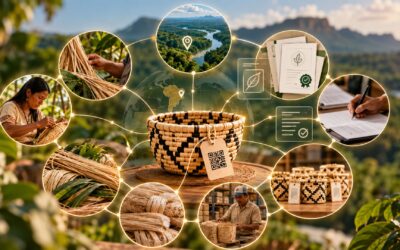
Large suppliers typically have sales departments, management systems, compliance structures, and standardized documentation. For a small producer, building this same infrastructure may not be feasible. This is precisely where digital traceability can serve not only as a control tool but also as a mechanism for business organization. Products, producers, regions, materials, processes, batches, documents, and evidence can be structured around a digital identity that tracks the item throughout its journey.
A business passport, not a certification
The term “commercial passport” helps clarify this function, provided it is used with care. We are not referring to an official document that replaces certificates, licenses, declarations, or customs requirements. We are referring to an informational framework capable of bringing together the information a product needs to present to different stakeholders. A buyer may consult commercial information; an importer may need certain documents; the end consumer may access information on origin and authorship. The identity remains the same, while the layers of information vary.
For handmade products, this capability can be particularly important. A photograph shows color, shape, and finish, but it rarely reveals traditional knowledge, place of origin, authorship, generational continuity, or the complexity of the technique used. In the digital environment, a handmade product and an industrial reproduction can appear side by side and seem equivalent. If the only available criteria are appearance and price, the small producer finds themselves in a structurally unfavorable competitive situation. When other attributes become visible and can be linked to evidence, the comparison takes on new dimensions.
Bioeconomy and Natural Products
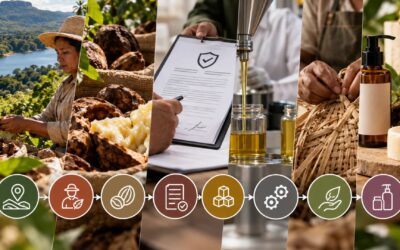
This logic also applies to bioeconomy supply chains. Oils, extracts, fibers, seeds, and other natural products may involve different territories, organizations, processing stages, and commercial agents. For a small foreign company interested in purchasing these products, understanding the supply chain can be just as important as negotiating price and quantity. Traceability can help organize this information and reduce some of the information asymmetry between a small producer based in Brazil and a buyer who has never visited the producer’s operation.
This does not mean turning every producer into a large documentation-focused corporation. The goal should be proportionality. The information needed for a negotiation must be organized without creating a system so complex that it excludes precisely those it is meant to help. Technology applied to small supply chains must take into account operational simplicity, varying levels of digital maturity, and the ability to record evidence gradually.
More information does not necessarily mean better information
There is a common pitfall in transparency initiatives: assuming that the more data is displayed, the greater the trust will be. In practice, an excess of information can make decision-making more difficult. A buyer does not need to view hundreds of technical fields to understand a product. They need to quickly find the information relevant to their analysis.
That is why digital identities need to operate in layers. Consumers can view origin, materials, history, and care instructions. B2B buyers can access production capacity, batches, or commercial documents. An importer may need different documentation. The company maintains internal information that is not public. The value lies less in the amount of data presented and more in the ability to organize the information that each stakeholder needs to know.
Traceability is no substitute for export preparation
Another important consideration is not to treat traceability as synonymous with international readiness. A product may have excellent documentation, yet the company may still not be prepared to export. A website, communication, pricing, logistics, documentation, customer service capabilities, market knowledge, and commercial strategy remain fundamental. In this context, the SERX—SUIDChain Export Readiness Index —broadens the discussion by evaluating factors related to readiness for international markets.
This combination is important because it links product identity to business capability. It’s not enough to have a good story. You have to be able to turn it into a business proposition, serve customers, meet requirements, and deliver. Technology should support this journey, not hide its complexities.
Small orders also provide insights
Small-scale wholesale also has a strategic advantage: it allows companies to learn through smaller transactions. A first order can serve as a test of a particular market. A second buyer may indicate that there is demand in that region. A product category may be more widely accepted in one country than in another. Over time, small sales provide market signals that can guide future decisions.
When these signals are linked to product identity, it opens the door to a new layer of intelligence. SUID Intelligence is based precisely on this perspective: a product’s commercial trajectory can yield insights into market presence, distribution channels, interactions, and product behavior in different contexts. For small businesses that would otherwise have little access to large-scale business intelligence systems, leveraging data generated by their own operations can represent a significant opportunity.
Expand internationally without losing what makes the product unique
Small-scale wholesale breaks down a long-standing barrier to international trade: the need to start big. Small producers can test markets with smaller volumes, and buyers can try out suppliers without taking on excessive risk. However, if this digital expansion turns unique products into mere photographs competing for the lowest price, some of that potential will be lost.
Traceability does not guarantee economic value and does not eliminate the importance of price, quality, delivery time, or logistics. What it can do is expand the range of information available for decision-making. Origin, authorship, materials, techniques, territory, and evidence are no longer hidden. Small-scale producers may never operate on a large scale, but they can offer something that certain buyers seek precisely because it is not mass-produced. The challenge is to ensure that, when entering the international market, they do not have to leave their identity behind.