When a Product Continues to Tell Its Story After the Sale: Traceability in Multichannel Chains

Imagine the journey of a single product. It is created by a manufacturer, listed on a B2B platform, purchased by a small international distributor, added to another seller’s catalog, made available through a dropshipping operation, listed on a B2C marketplace, promoted on social media, and finally purchased by a consumer in another country.
Throughout this journey, virtually everything can change: the seller, the platform, the price, the description, the packaging, the internal code, the market, and even the language used to present the product. This ability to move between different channels is one of the most important characteristics of contemporary commerce, but it also exposes a vulnerability: with every commercial change, part of the product’s original identity may be lost.
Each platform has its own listing logic. SKU, title, description, category, price, inventory, photos, and logistics information are created according to the needs of that system. This fragmentation is understandable and necessary from an operational standpoint. The problem arises when fundamental information about origin, authorship, materials, processes, and evidence depends exclusively on these listings. If a distributor does not replicate a particular attribute, it disappears. If a marketplace has limited fields, part of the story is lost. If another seller creates a new description, the information may be reinterpreted. Commerce becomes multichannel, while identity remains fragmented.
An identity that extends beyond the sales channel
Persistent digital identity proposes a different architecture. Instead of each platform representing a new digital existence for the product, certain information remains linked to an identity that is independent of the channel. Origin, manufacturer, materials, processes, batches, documents, and evidence can make up this layer, while marketplaces, distributors, and sellers continue to maintain their own commercial records.
This does not mean creating a centralized system that replaces all others. On the contrary. The logic is one of interoperability. ERPs, marketplaces, logistics systems, B2B platforms, and other tools can continue to perform their specific functions. Digital identity serves as a reference point capable of maintaining informational continuity across different environments. The product ceases to exist merely as a line item in each seller’s catalog and instead carries a history that can travel across channels along with it.
The physical and the digital come together again
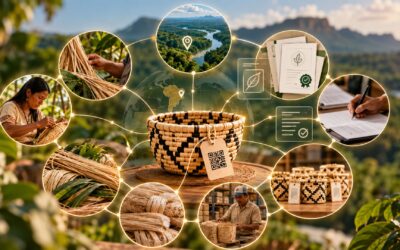
When a physical product has a QR code linked to its identity, a particularly interesting bridge is formed between these two dimensions. In the SUIDChain ecosystem, the SUIDPass can fulfill this role, allowing packaging, labels, or physical documentation to provide access to specific digital information. Consumers can learn about the product’s origin and materials; professional buyers can access additional information; and authorized agents can view specific documentation.
Once again, it is important not to confuse the interface with the infrastructure. The QR code is not traceability. It is merely one way to access the product’s identity. The value lies in the relationships established between the product, agents, events, documents, and evidence. If these relationships remain consistent, the product can move through different channels without having to reconstruct its history with every new sale.
One identity, different information campaigns
A handcrafted item illustrates this logic well. For the producer, it may be important to document authorship, technique, materials, and place of origin. For a distributor, dimensions, restocking ability, country of origin, and commercial documentation may be more relevant. The retailer needs information to present the product accurately. The consumer wants to understand who made it, where it came from, and how to care for it. These are distinct needs, but they all relate to the same object.
This ability to present different layers is essential because transparency does not mean unrestricted disclosure. Some information is public; other information pertains to B2B relationships; and still other information may be confidential. A good traceability architecture must manage these boundaries and allow each participant to see only what is relevant to their role in the chain.
Traceability starts by looking back, but you can learn to look ahead
Historically, the central question of traceability has been retrospective: Where did it come from? Who produced it? What raw materials were used? Which batch? These elements remain fundamental. However, a persistent identity opens up the possibility of also tracking the product’s subsequent journey. In which markets did it appear? Through which channels did it circulate? Where was its identity checked? Which categories showed the greatest commercial presence? In which regions did certain products spark interest?
This perspective transforms the commercial trajectory into a new layer of information. The product is not merely the result of a production chain; it is also part of a market chain. In SUID Intelligence, this perspective can help interpret commercial presence, routes, and signals generated by the movement of products. For small producers, this is particularly relevant because visibility often ends with the first buyer. Once a distributor purchases the product, the producer may no longer know where it ends up or which markets it is reaching.
A sale doesn't have to mean the end of the digital relationship
Another important consequence is that checkout is no longer necessarily the final stage of the information journey. Traditionally, after payment and delivery, the product virtually disappears from the commercial system, except when there is a new purchase, exchange, or customer service interaction. With a persistent digital identity, it can remain connected. Consumers can look up information, access guidance, learn about relevant updates, or better understand the history of that item.
For brands and manufacturers, this continuity can create a different relationship with the market. The physical product becomes a point of contact that can remain active after the transaction. This does not mean turning every object into a tool for monitoring consumers; any use of data must respect privacy, consent, and governance. It simply means recognizing that the product’s identity can continue to exist after the sale is complete.
Maintaining visibility throughout the intermediary stages
This architecture can also help address a historical characteristic of supply chains: the greater the number of intermediaries, the greater the likelihood that the producer will disappear from the narrative. The brand appears, the distributor appears, the marketplace appears, and the seller appears, while the producer becomes invisible. In crafts, agriculture, the bioeconomy, and natural products, this loss can be particularly significant because origin and authorship are often integral to the product’s value itself.
A digital identity does not eliminate intermediaries, nor should it. Distributors, retailers, marketplaces, and logistics operators play important economic roles. The key is to ensure that the expansion of the commercial chain does not necessarily require the elimination of the production chain. A product can reach new markets while maintaining connections to its origins.
The channel may disappear; the identity must survive
Finally, there is a strategic dimension. Marketplaces change, sellers shut down operations, platforms are replaced, and companies switch channels. If a product’s entire digital identity is confined to a single marketplace, some of that information may disappear when the business relationship ends. A persistent identity creates greater continuity and can facilitate future integrations through APIs and other interoperability mechanisms.
This evolution also transforms the way we think about traceability itself. A product that is simply traced primarily answers the question, “Where did I come from?” A connected product can also begin to answer questions such as “Where have I been?”, “In which markets am I present?”, “What evidence is associated with me?”, and “How does my story continue after the sale?” Traceability now functions as an infrastructure for identity, relationships, and intelligence, without abandoning its original function of connecting events and information throughout the supply chain.
E-commerce will continue to become more multichannel. Products will move between B2B platforms, distributors, dropshippers, B2C marketplaces, social media, and consumers who may never have any direct relationship with one another. In this scenario, the issue isn’t preventing the product from changing channels. It’s ensuring that each change doesn’t force its story to start over. The channel may change, the seller may change, the country may change, and the packaging may change. The product’s identity, however, should be able to accompany it throughout this journey.