Dropshipping from the Source: How Traceability Can Reduce Invisibility in Supply Chains
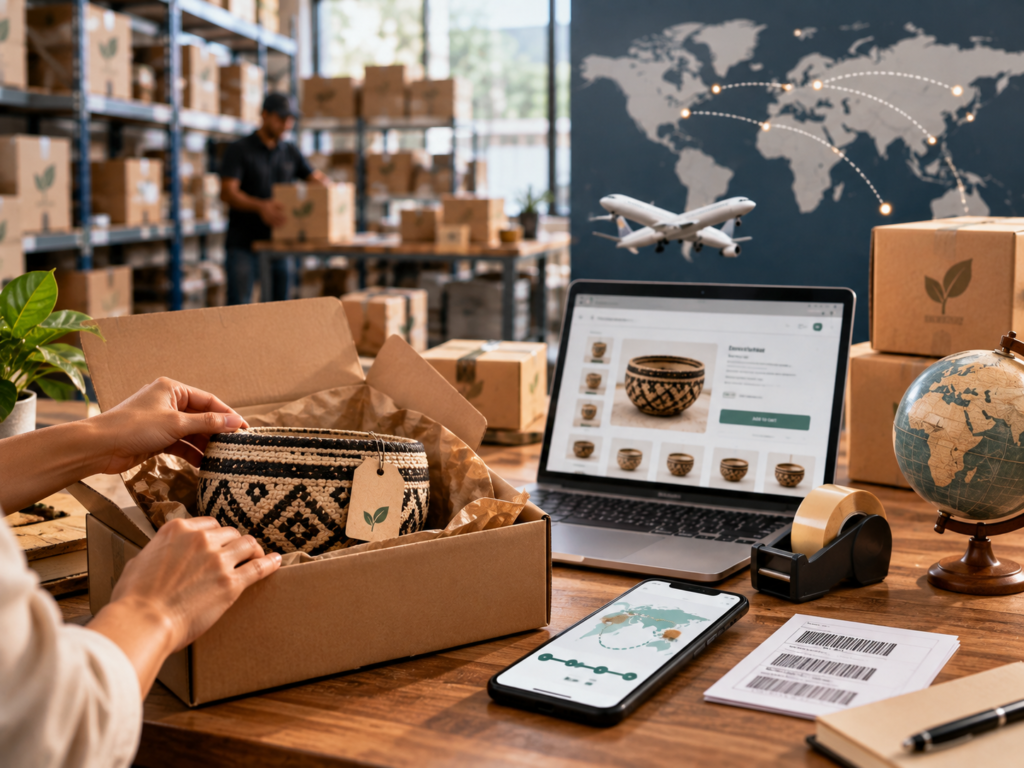
Dropshipping has become one of the clearest examples of the decentralization of e-commerce. A seller can sell a product that has never physically passed through their inventory, while the supplier handles the logistics either directly or through other operators.
Producers, suppliers, online sellers, marketplaces, logistics operators, and consumers may be located in different countries and still participate in the same transaction. This model reduces certain barriers to entry, expands the ability to test markets, and allows products to reach consumers who might never have been served by a conventional distribution structure. At the same time, it creates a contradiction that is rarely discussed: the more decentralized the commercial operation becomes, the greater the distance between the consumer and the actual source of what they are buying.
Imagine a handmade item produced by a small organization. A supplier adds the product to its catalog, a seller located in another country decides to offer it via dropshipping, and the listing is subsequently replicated on various marketplaces. Photos are reused, titles are optimized for search engines, descriptions are shortened, and attributes deemed irrelevant to conversion may be omitted. By the time the product finally reaches the consumer, the commercial transaction has gone off without a hitch, but the story behind its creation may have been reduced to a few words—or may have simply vanished. The supply chain has gained reach and efficiency, while the producer who made the product possible has become invisible.
When Every Salesperson Rewrites the Story
One of the characteristics of distributed digital commerce is that different sellers can create their own descriptions for the same item. This can lead to a kind of informational game of telephone. “Handcrafted by a particular community” can become “handmade,” which later turns into “artisan-style.” A fiber from a specific region may appear simply as “natural fiber.” After successive repetitions, information that was originally accurate can be simplified, distorted, or transformed into a marketing claim that is much broader than what the data actually supports.
Digital traceability offers another possibility by separating the product’s identity from the description created by each seller. If origin, authorship, materials, processes, batches, documents, and evidence remain linked to a persistent identity, the seller remains free to determine price, promotion, positioning, and commercial strategy, but does not need to reconstruct from scratch all the information about what they are selling. This layer does not prevent the existence of multiple listings; it creates a reference capable of preserving certain information as the product moves through different channels.
Dropshipping from the source
This architecture enables a particularly interesting concept for handmade products, the bioeconomy, natural ingredients, and other specialized supply chains: dropshipping with traceability. The logistics model remains decentralized, but the product’s identity does not need to be fragmented into disconnected versions. A SUIDPass, for example, can physically accompany the item via a QR code and serve as a gateway to information associated with its digital identity. The consumer who receives the merchandise can learn its origin even if they purchased it from a seller who never physically handled that product.
For the producer, this can maintain visibility. For the seller, it offers a more consistent source of information and content. For the consumer, it enhances the ability to understand what they have received. For professional buyers, the same identity can provide access to additional layers of information, such as documents and commercial data that do not need to be publicly available. The principle is simple: different participants can access different information, but they all relate to the same product.
Crafts, Authorship, and the Risk of Commoditization
This logic becomes particularly relevant in the field of handicrafts. When a handmade piece enters a retail chain, there is a risk that its authorship, origin, and technique will gradually be replaced by purely aesthetic attributes. The object is no longer perceived as the result of specific production knowledge and begins to compete with any visually similar item. In digital markets, this transformation can happen quickly because algorithms group products by categories, keywords, price, and purchasing behavior—not necessarily by the complexity of their production chains.
Digital identity does not eliminate competition or guarantee economic value, but it creates the conditions for preserving information that helps the market recognize differences. A handmade item can continue to circulate through distributors and dropshippers without its origin having to be obscured. This allows us to distinguish between two issues that are often confused: expanding distribution does not have to mean erasing the identity of the producer.
Natural Products and Distributed Supply Chains
The same issue arises with natural products and ingredients. An oil, extract, fiber, or seed may pass through a producer, processor, supplier, distributor, and seller before reaching the end buyer. In some cases, certain information must accompany the product; in others, it must remain restricted to authorized parties. A traceability architecture allows for different levels of access without reducing the entire chain to a single commercial description.
This also helps preserve context. An attribute related to the raw material should not automatically be interpreted as an attribute of all subsequent stages. A certification from a particular organization does not necessarily extend to any company that resells the product. By linking information to the corresponding actors and stages, traceability can reduce the risk that claims become progressively broader as they move through the chain.
Traceability does not eliminate fraud
It is equally important to recognize the limitations of technology. A QR code can be copied. Packaging can be replicated. A document may contain incorrect information. A statement may have been provided by the interested party themselves. Therefore, digital traceability should not be presented as an automatic solution to counterfeiting or fraud. Its value depends on governance, identity verification, data quality, and clarity regarding the origin of the evidence.
The more distributed the supply chain, the greater this need. Rather than simply displaying information, traceability systems must indicate where the information came from, who recorded it, and its level of validation. This transparency is particularly important in dropshipping operations because different parties may never have direct contact with one another.
Logistics can be invisible without production being invisible as well
Dropshipping has made part of the logistics process invisible to the consumer. A consumer buys from one store and may receive the product directly from another provider. This invisibility is part of the model’s efficiency and is not necessarily a problem. What needs to be questioned is whether logistical invisibility must necessarily lead to invisibility in the supply chain. The two can be separated.
Consumers do not need to know all the details of internal inventory movements to understand who manufactured the item, what materials were used, or where it came from. Similarly, sellers do not need to disclose confidential business information to protect the identity of the manufacturer. A good data architecture makes it possible to establish these boundaries.
When circulation also leads to intelligence
There is also a second opportunity. When a digital identity accompanies the product, its interactions can generate signals about its commercial circulation. Markets where the product appears, channels used, identity queries, and presence patterns can yield useful information. This is where SUID Intelligence expands the concept of traceability: the product no longer carries only information about its origin but also begins to provide insights into its commercial journey.
This can be especially valuable for small producers, who often lose track of their products as soon as they sell them to the first intermediary. In a distributed supply chain, understanding where a particular item is headed can help with market strategy, business planning, and identifying new opportunities.
The great advantage of dropshipping is that it allows distribution to scale without requiring each seller to replicate the entire logistics infrastructure. The next challenge may be to enable this scaling to occur without sacrificing the product’s origin. Manufacturers, suppliers, dropshippers, marketplaces, and consumers can remain independent actors. The goal is not to eliminate intermediaries, but to create informational connections capable of preserving what gives the product its identity. In this way, commerce can remain global, distributed, and efficient without the product having to forget where it came from with every new sale.