How Traceability Transforms Recycled Materials into Assets in the Circular Economy
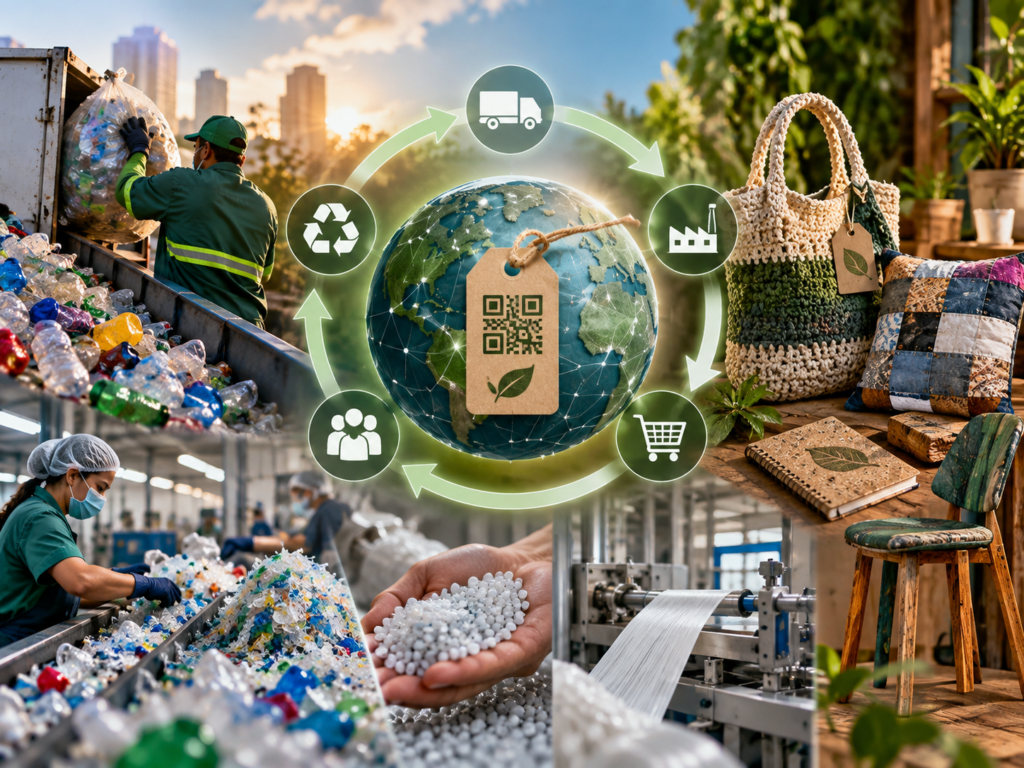
The circular economy is often presented as a shift in the way we use resources: materials that would previously have reached the end of their useful life can be recovered, reused, recycled, or transformed, thereby re-entering new production cycles. But there is a less visible aspect of this transformation that deserves attention.
When a material moves from one supply chain to another, what happens to the information that explains its origin, composition, journey, and transformation? In many cases, that information disappears just as the material begins a second life.
The final product may reach the market labeled as recycled, reused, or produced through upcycling, while much of the process that would support that claim remains scattered among suppliers, producers, cooperatives, artisans, documents, photographs, spreadsheets, and informal records.
This gap is particularly significant in supply chains that combine circularity and artisanal production. Scraps from garment manufacturing can be transformed into patchwork quilts, placemats, bags, and decorative items. Garments can be taken apart and reconstructed into new products.
Reclaimed wood can take on a new purpose in the hands of woodworkers and artisans. Glass, fibers, packaging, tarps, metals, and various production byproducts can be reinterpreted through upcycling. In these cases, the value of the product lies not only in the final object: there is also value in the material’s journey, in the knowledge applied to its transformation, in its authorship, and in the region where that new production cycle took place.
Circularity doesn't start with the final product
When we look at a handmade patchwork bag, we see the result of a transformation, but we cannot necessarily trace the history of the materials used. Those fabrics may have come from industrial surplus, cutting scraps from small garment factories, unsold inventory, or previously used items.
These origins are different and should not automatically be lumped into the same category. Recycled material, reused material, and repurposed material are not necessarily the same thing, just as upcycling does not simply mean recycling. The more mature the discussion on circularity becomes, the greater the need to communicate these differences accurately.
Traceability can help precisely in this regard by establishing connections between stages that normally remain isolated. Instead of recording only the final product, it becomes possible to organize information about the receipt of materials, their declared origin, the supplier or responsible organization, sorting and processing procedures, production batches, ownership, and available documents.
This does not mean that every circular supply chain needs to track each piece individually. A small patchwork piece, for example, may consist of dozens or hundreds of scraps, making it impractical to identify each one individually. Models based on lots, collections, or groups of materials may be more appropriate, as long as they clearly specify the level of detail in the information.
When Handicrafts Connect Different Production Cycles
Crafts occupy a particularly interesting position in this discussion because many practices now associated with the circular economy are part of a body of productive knowledge that has been in use for generations.
Reusing fabrics, rebuilding objects, using scrap wood, recovering fibers, or transforming locally available materials did not begin with the term “circular economy.” In many communities, these practices arose out of necessity, creativity, the availability of resources, or the passing down of knowledge from one generation to the next.
Patchwork is a prime example. Fragments that, taken individually, might have little use are reorganized and transformed into a new composition. Value now lies both in the material and in the human ability to select, combine, and reconstruct it.
Something similar happens in upcycling: an existing object or material is reinterpreted to take on a new function, often without undergoing the same type of industrial processing involved in conventional recycling. Recognizing these differences allows us to highlight the value of the process without resorting to generic claims of sustainability.
When information about origin, authorship, and transformation accompanies these products, the consumer or buyer begins to see something that would normally remain invisible. A bag is no longer just a bag made from scraps. It can be understood as the result of a specific flow of materials, associated with a particular production group, a technique, a territory, and a specific transformation process.
From Narrative to the Chain of Evidence
There is, however, an important difference between telling a story and building a body of evidence to support it. Photographs of the process can demonstrate specific stages. Supplier statements can document the reported origin of materials. Commercial documents can establish relationships between organizations. Batch records can show which materials were used in a specific production run. Certifications, audits, or declarations of conformity—when available and applicable—add further layers of evidence.
None of these forms of evidence should automatically be treated as equivalent to the others. The credibility of a traceability infrastructure depends precisely on the ability to distinguish between what has been declared, documented, certified, audited, or verified. This distinction prevents traceability from being confused with certification. A traceability solution can link different forms of evidence, but it does not transform a declaration into a certification simply because it has been digitized.
This approach is particularly important for small-scale producers and artisanal supply chains, where sophisticated certification systems may not always be in place. Building traceability can begin gradually, by organizing existing records and improving the quality of the evidence as the operation matures.
SUIDChain and the Digital Identity of Circular Products
It is within this context that SUIDChain™ works with the concept of digital product identity. Through a SUID, various pieces of information can be organized and linked to the product, collection, or batch: origin, territory, authorship, materials, production processes, documents, evidence, batches, and commercial presence. For products originating from the circular economy, this architecture allows for the recording not only of what the product is today, but also of elements related to the trajectory of the materials that contributed to its existence.
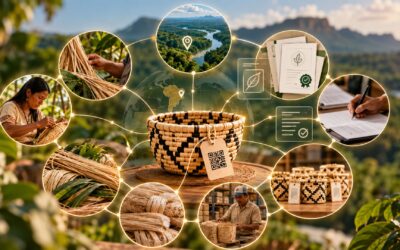
SUIDPass acts as a bridge between the physical product and its digital identity. Through a QR code, different audiences can access the information provided about that product’s journey. A handcrafted patchwork piece, for example, can display data on the production group, the technique used, reused materials, the production region, and selected evidence.
An upcycled item can document aspects of its previous condition and its transformation. The goal is not to add a technological layer just for the sake of adding technology, but to prevent relevant information from being lost when the product moves to a new stage, channel, or market.
When Traceability Also Generates Insights
Organizing this information opens up yet another possibility. When data on different products, lots, materials, and markets begins to be structured, it can yield insights that go beyond a simple query about a single product. SUID Intelligence builds on this foundation to correlate information on product trajectories, market presence, life cycles, and market signals, enabling companies and organizations to better understand how their products circulate and what insights are being generated along that trajectory.
A cooperative that works with reclaimed fabrics could, for example, begin to identify which types of materials are most frequently used in its production, which collections use specific batches, which techniques are associated with different products, and in which markets these pieces appear. For larger organizations, this framework can help consolidate information from different suppliers and regions. Circularity thus ceases to exist merely as a communication tool and begins to generate data about the supply chain.
Circularity and Preparation for International Markets
There is also an important commercial aspect. A handmade or circular product may have an excellent origin story and yet still not be ready to enter international markets. Exporting involves documentation, product classification, logistics, commercial channels, production capacity, communication, compliance with market requirements, and various other factors. Therefore, sustainability and circularity are no substitute for export readiness.
SERX—the SUIDChain Export Readiness Index—operates at this other level by providing a structured assessment of an organization’s level of readiness for international markets. For cooperatives, small producers, upcycling brands, and artisan businesses, this assessment can help identify gaps between having a product that is potentially attractive to international buyers and having an operation that is effectively prepared to serve them.
The value lies not only in the recovered material
A truly circular economy does not depend solely on the ability to keep materials in circulation. It also depends on the ability to understand what happens to them throughout that cycle. When a scrap of fabric leaves a garment factory and reaches the hands of a craftsperson, when a piece of clothing is transformed into a bag, or when reclaimed wood is given a new purpose, there is a transition between production cycles. If no information accompanies this transition, an important part of the story is lost.
Traceability does not create circularity on its own. A product does not become sustainable simply because it has a QR code, blockchain, or digital identity. Technology does not replace responsible production practices. The role of digital infrastructure is different: to help record, organize, correlate, and make available information that allows for a better understanding of what actually happened.
When origin, materials, transformation, authorship, territory, and evidence remain interconnected, what would previously have been perceived merely as waste can acquire a more complete identity within a new production cycle. And perhaps this is one of the next advances in the circular economy: not only extending the life of materials, but also preserving the memory of their transformations.