When Origin Has Value: How Traceability Transforms Invisible Attributes into Perceived Value

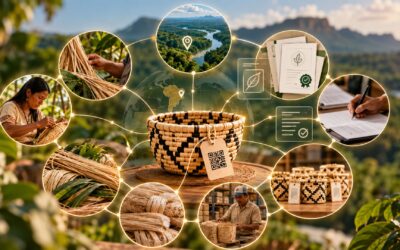
There are products that come onto the market carrying much more than meets the eye. A basket may be made from a fiber that grows in a specific region and requires knowledge of the right time to harvest, prepare, and dry it. A piece of pottery may be crafted from clay whose texture has been known to a community for generations.
A fabric can preserve, in the pattern of its weave, the memory of a technique learned by observing the hands of earlier generations. A wooden object can trace its history back long before it was crafted—to the species of wood used, the forest where it came from, and the people who knew how to transform raw material into form.
When these products reach a store, a marketplace, or an international buyer, however, much of that journey disappears. What remains are the photograph, the dimensions, the composition, perhaps a few lines of description, and, almost always, the price. Everything that happened before that moment continues to exist within the product, but it has become invisible to those on the other end of the chain.
This invisibility helps explain one of the major challenges faced by artisanal, regional, and small-scale products. Technique, craftsmanship, production time, traditional knowledge, the origin of materials, and relationships built throughout the supply chain are real attributes, but they are not always visible.
And what the market cannot see, it can hardly incorporate into its perception of value. Two objects may appear similar on a screen, yet have profoundly different production histories. One may have been produced on an industrial scale, using standardized processes and global supply chains; the other may have taken days to complete, used local raw materials, relied on a family’s expertise, and generated income within a specific region. When these differences are not conveyed to the buyer, the comparison naturally tends to focus on what remains visible: appearance, functionality, and price.
It is precisely in this gap between what the product is and what the market perceives it to be that traceability begins to take on a different role. For a long time, traceability was associated primarily with locating goods, identifying lots, managing inventory, or reconstructing logistics routes.
These functions remain essential, but a new layer is emerging. Tracing can also help preserve relationships: connecting a product to the region where it originated, to the people involved in its production, to the materials used, to the processes carried out, to existing documents, and to evidence that supports the information being communicated.
Traceability, then, is no longer just a tool for answering “Where is it?” or “Where did it come from?” but begins to address a deeper question: What is inside this product that I cannot see just by looking at it?
This does not mean that traceability creates value on its own. This distinction is essential. No QR code automatically makes a product more valuable. No digital record guarantees a premium price. No blockchain transforms an ordinary item into an object sought after by the market.
Value continues to depend on quality, design, functionality, demand, positioning, trust, cultural context, commercial capacity, and countless other variables. What a traceability infrastructure can do is different: it allows attributes that already exist to be recorded, organized, and presented in an understandable way. Rather than inventing a narrative to add value to the product, it helps preserve the narrative that was inherent in it from the start. Rather than artificially creating differentiation, it can make demonstrable the differences that have always been present but were lost between the point of origin and the market.
This transformation is particularly relevant for handmade products because a significant portion of their value lies not only in the material itself, but in the knowledge applied to it. Clay does not turn into pottery on its own. Fiber does not turn into basketry on its own. Yarn does not decide how it will be woven.
Between the raw material and the object there is a person, and within that person there is a body of knowledge built on experience, observation, learning, memory, and, often, intergenerational transmission. When the market sees only the final object, all this knowledge runs the risk of being reduced to a generic category: “handmade.” The word may be accurate, but it still falls short of capturing the complexity it attempts to represent. Recording authorship, technique, territory, and process does not mean turning culture into a form. It means recognizing that there is knowledge within what we buy and that this knowledge also contributes to the creation of value.
Territory adds another dimension. Origin is not just a point on a map. A territory encompasses climate, biodiversity, the availability of raw materials, knowledge, social relationships, productive practices, and collective histories. Certain techniques exist only because people learned to work with what the environment provided them.
Certain materials possess characteristics related to the place where they were produced or collected. When information about a territory accompanies the product, the market no longer receives merely a geographic location but begins to understand context. And context changes perception. An object ceases to be simply another item within a category and comes to occupy a place within a larger history of production.
Traceability can also bridge the gap between narrative and evidence. Storytelling will continue to be a powerful tool for products with a distinct identity, because people don’t just connect with data; they connect with stories. But there is an important difference between a story that is told and a story that is substantiated.
Photographs of the process, production records, identification of the territory, information on materials, authorship, associated organizations or cooperatives, documents, and batch data can provide different levels of evidence. It is not necessary to turn the shopping experience into an audit, nor to disclose all available information.
A consumer may receive basic, user-friendly information; a B2B buyer may access additional information; an importer may need specific documents; and an organization that tracks impact may work with a different level of detail. The product’s digital identity can serve precisely as this point of connection between different audiences and a single source.
There is also an economic issue underlying this discussion. Supply chains often make the stages closest to the market highly visible, while those at the source remain largely hidden. We are familiar with the brand, the store, the marketplace, and the final product, but we don’t always know who supplied the raw materials, who mastered the technique, or which community was involved in that production.
This information asymmetry is not the only reason for economic asymmetries within supply chains, and it would be naive to claim that traceability alone will resolve issues of income or value distribution. However, what goes unrecognized cannot even fully enter the conversation about value. Giving visibility to the participation of producers, territories, and knowledge can create the conditions for more informed commercial relationships, more consistent differentiation strategies, and a more complete understanding of what truly underpins a given product.
Perhaps that is why the contemporary discussion on traceability is shifting from being exclusively operational to also becoming a discussion about identity. A product can carry a kind of digital memory: where it came from, who was involved in its creation, what materials were used, what processes took place, and what evidence exists along that journey. This memory does not replace human experience, but it prevents everything from being erased when the product changes hands, crosses borders, or enters a marketplace. The greater the distance between the producer and the buyer, the more important this ability to convey context may become.
At its core, the issue is simple and deeply human. There is great value that arises even before a price is set. It arises from the knowledge of those who recognize a raw material, from the hands that have mastered a technique, from the land that provides resources, from the time devoted to a piece, and from the relationships that allow a particular activity to continue to exist.
For a long time, part of that value was lost along the way because there was no infrastructure to ensure it traveled along with the product. Traceability offers the possibility of changing that—not to turn every story into data, but to prevent commercial data from erasing the story.
Not to promise that every origin will be rewarded by the market, but to create the conditions so that it can be known, demonstrated, and recognized. Because, before asking how much a product costs, perhaps we need to learn to see everything that had to exist for it to reach us.