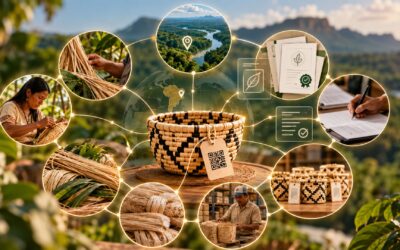
Furniture doesn’t start at the factory: traceability as the link between the forest, design, industry, and the global market

When we look at a finished chair in a showroom, a table set up in a hotel, or a Brazilian object on display in an international store, it’s natural to focus our attention on what’s right before our eyes: shape, finish, functionality, texture, color, and design. But the product we see is merely the final visible stage of a much larger chain. Before the factory, there was raw material.
Before the raw materials reached the factory, there were territories, suppliers, documents, and processes. During manufacturing, batches, transformations, quality controls, and ownership emerged. After leaving the factory, other stages begin: export, import, distribution, retail, use, and, eventually, repair, resale, or new cycles. A piece of furniture is, therefore, a point along a trajectory, not the beginning of it.
This insight changes the way we think about traceability. For a long time, traceability mainly meant looking back to find out where a particular material came from. That remains an essential function, but digitization allows us to expand the concept. If we can preserve the relationships between origin, material, processing, design, product, and market, traceability can become an infrastructure that tracks different stages of the life cycle.
The physical chain continues; information often disappears
Wood travels the entire physical supply chain. It leaves its source, undergoes processing, reaches the factory, is transformed into a component, becomes a piece of furniture, is packaged, exported, and sold. Information, however, does not always follow the same path. At some point, a specific species may simply become “wood.” A region may become simply “Brazil.” The supplier disappears from the commercial record. The batch remains inside the factory. Documents are filed away. Certification becomes a logo. Ownership is separated from production records.
This information gap reduces the ability to understand the product.
It also reduces the amount of information that can be conveyed.
Brazil boasts a particularly interesting combination of natural resources, industrial capacity, architecture, design, and handicrafts. When these elements remain disconnected, the final product may reach the international market without embodying many of the attributes that make it unique.
SUID: Connecting Materials and Products
SUIDChain™ works with SUID, a digital identity capable of linking product-related information throughout a product’s lifecycle. For a piece of furniture, this may include species, material, region, supplier, lot, production facility, processes, documents, applicable certifications, authorship, design, and commercial presence.
The goal is not simply to create a longer technical specification.
It's about maintaining relationships.
A product specification sheet states that the chair is made of a specific type of wood.
A traceability framework aims to link that information to the material, batch, supplier, and corresponding records.
This difference turns isolated data points into a chain.
The design also has its origins
There is one aspect that is particularly relevant to furniture and home decor: authorship. When we talk about forest traceability, it’s natural to focus on the material origin. But a product with higher added value can have both a physical origin and a creative origin.
Where did the wood come from?
Who designed the play?
Where was it manufactured?
What technique was used?
Who was involved in the production?
What materials were incorporated?
What evidence supports the claims made about the product?
These questions help preserve a dimension that is often lost when products cross borders. Brazilian design can be part of a product’s traceable identity, not just a marketing tool.
SUIDPass: The product becomes an access point
SUIDPass creates the link between that identity and the physical object. A QR code can provide access to selected information about the supply chain. This transforms the product itself into a gateway to its documented history.
At an international showroom, an architect can access technical and material information. A corporate buyer can review other documentation. A consumer can learn about the manufacturer, origin, design, and specific production characteristics. The company can keep sensitive information secure in restricted environments.
This architecture is particularly interesting because it continues to exist after the product leaves the factory.
Identity doesn't have to end with the sale.
FSC, documents, and technology: every piece of evidence in its place
When applicable FSC certification is available, it may be incorporated into the digital identity in accordance with its scope. When official documents related to the supply chain exist, they remain linked to the responsible authority. When certain information constitutes a corporate statement, its nature must also be preserved.
This distinction prevents the digital passport from becoming a “super certificate” that appears to validate everything.
That shouldn't be your role.
A passport connects people.
Certification certifies.
The document serves the purpose for which it was issued.
The audit verifies within its scope.
Technology shapes relationships.
The clearer this separation is, the greater the trust in the architecture as a whole can be.
SUID Intelligence: When the Supply Chain Meets the Market
There is a subsequent step that deserves attention. Once we understand where it came from and how it was produced, we can ask: Where is this product?
SUID Intelligence adds this dimension to the SUIDChain offering, linking digital identity to indicators of commercial presence, trajectory, lifecycle, and market intelligence.
For Brazilian manufacturers, this can bridge the gap between traceability and business decisions. Certain collections may have a stronger presence in specific regions. Certain categories may be sold through different channels. Some markets may show greater interest in certain attributes.
Traceability then begins to generate a new layer of value: intelligence.
Not just a taste of the past.
Learning from the journey.
SERX: Before the product crosses the border
There is also a step that comes before international trade: determining whether the company is ready to export.
An excellent product may face challenges in international markets due to issues that are not directly related to quality or traceability. Inadequate communication, a lack of sales infrastructure, poorly planned logistics, incomplete documentation, a lack of a market strategy, or insufficient digital readiness can limit international expansion.
The SERX — SUIDChain Export Readiness Index operates in this area, providing an assessment of export readiness.
The ecosystem then goes through different phases:
SERX → Preparing the company for international markets.
SUID → product's digital identity.
SUIDPass → the link between a physical product and a digital identity.
SUID Intelligence → trajectory, commercial presence, life cycle, and intelligence.
These layers do not compete with one another. They address different issues within the same journey.
From the forest to the global market without losing any links
Perhaps one of the greatest opportunities for Brazilian furniture and home decor lies precisely in preserving relationships that are disappearing today.
The less information is associated with a raw material, the more easily it can be viewed simply as a commodity.
When we are able to organize elements such as territory, species, supplier, processing, design, authorship, manufacturing, documents, and evidence, the product takes on a richer identity.
That doesn't automatically mean a higher price.
Export is not guaranteed.
It does not guarantee sustainability.
But it reduces the invisibility of the chain.
And in markets where buyers are seeking to gain a deeper understanding of what they are purchasing, reducing this invisibility can become a competitive advantage.
Traceability shouldn't end once we find out where a particular raw material came from.
It can preserve the relationships that explain how that raw material became a product and how that product reached the market.
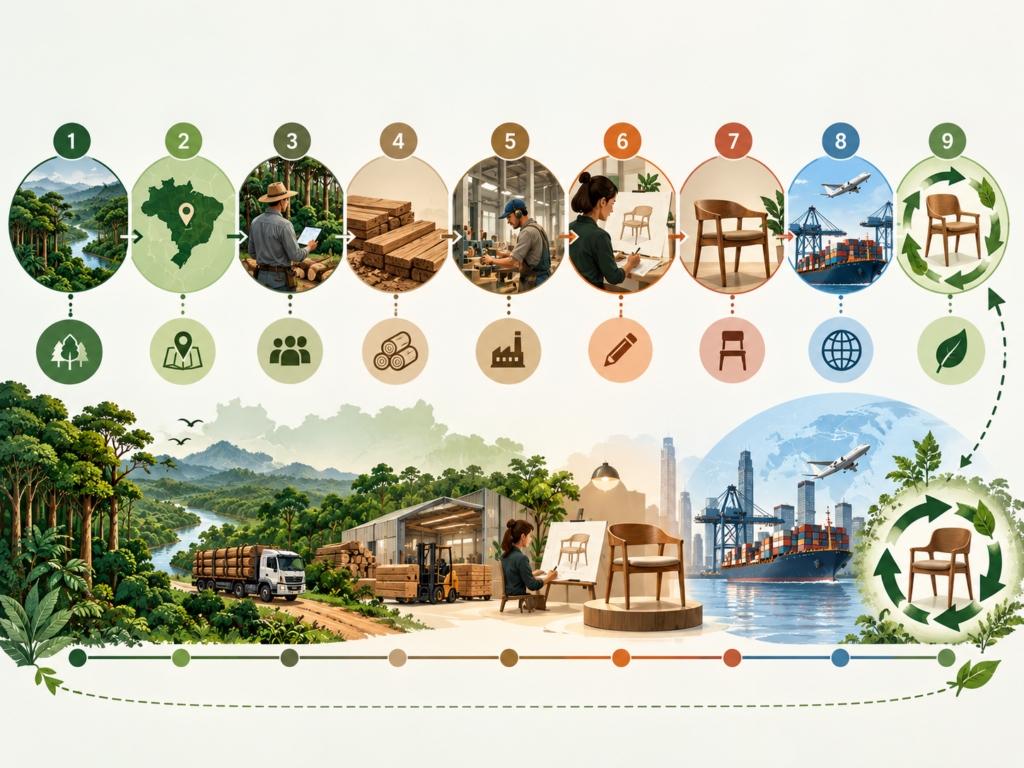
Forest → territory → supplier → material → industry → design → product → market → life cycle.
It is within this context that SUIDChain positions itself: connecting digital identity, evidence, business intelligence, and preparation for international markets.
Because furniture doesn't start at the factory.
And your identity doesn't have to end with the sale.