Digital Product Passport for Wood: Linking Species, Territory, Suppliers, Lots, and Documents

What is a chair’s digital identity? The question may seem strange when we think of an essentially physical object, produced to be used for years, and whose perceived value is typically associated with its design, materials, build quality, and finish. But one need only consider the amount of information that exists before that chair is ready to understand why a digital identity might be relevant.
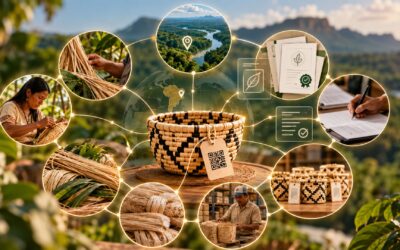
There is a type of wood, a source, a region, one or more suppliers, raw material inputs, processing methods, lots, a production facility, documents, any certifications, ownership, distribution channels, and market destinations. The physical object is merely the final manifestation of a chain that has already generated a large amount of data.
The problem is that this data is rarely integrated. Supplier information is in the ERP system. Documents may be stored in digital folders. Certificates are managed separately. Batch data remains in production. Specifications are in the catalog. Information on authorship is in marketing. Commercial data appears on marketplaces and in sales systems. When the product reaches the buyer, this complex structure is reduced to a technical data sheet. The concept of the Digital Product Passport proposes a change: transforming the product into a persistent point of connection between relevant information and evidence.
SUID: An Identity for Organizing Relationships
In SUIDChain™, this architecture begins with the SUID, the product’s unique digital identity. The goal is not merely to create an additional record, but to establish a persistent reference to which various pieces of information can be linked throughout the product’s lifecycle. For a piece of furniture or a wooden object, this may include commercial identification, SKU, manufacturer, materials, species, region, suppliers, lots, processes, documents, applicable certifications, authorship, and market presence.
The strength of this structure lies not simply in the number of fields available, but in the relationships between them. Knowing that a company purchases a certain type of wood is one piece of information. Being able to link a specific batch of that raw material to a production batch—and subsequently to the manufactured products—creates another level of traceability. The challenge is to move from independent records to a chain of relationships.
Species: Identifying the material is just the first step
In the timber industry, species information can be critical. Commercial names may vary across markets and regions, and, where applicable, the data architecture can link commercial names, scientific identifiers, and corresponding evidence. However, simply entering a species name into a system does not prove its presence in a given product. The following question must always be considered: Where did this information come from, and what evidence supports it?
This principle is important for the entire traceability architecture. Declared data, documented data, and verified data should not necessarily be treated as equivalent. A robust digital identity must preserve not only the information itself, but also its provenance.
Territory: “Made in Brazil” Tells Only Part of the Story
The country of manufacture and the origin of raw materials are different concepts. A piece of furniture can be produced in Brazil using materials sourced from different regions and suppliers. Depending on the supply chain and the applicable requirements, territorial information may vary in level of detail: country, state, municipality, production area, or more specific geographic data.
The Digital Passport makes it possible to structure these relationships without assuming that all information needs to be public. Certain data may be relevant for compliance or for B2B buyers, but not for the end consumer. Information governance is, therefore, an integral part of traceability itself.
Supplier and batch: where the chain really starts to come together
A company may know its suppliers and still have low traceability granularity. This occurs when it is unable to link raw material inputs to the manufactured products. The batch serves as a bridge between these two worlds. When an appropriate structure is in place, it becomes possible to establish relationships such as:
SUID → product → production lot → material → raw material lot → supplier → territory → document → record.
This sequence represents a significant change. Instead of simply asking, “From whom do we purchase wood?”, the company is now able to determine “Which raw materials are associated with which products?” The more precise this relationship is, the greater the ability to trace the supply chain.
A document is not synonymous with traceability
Another common misconception is to think that scanning documents solves the problem. A folder containing fifty scanned PDFs is still just a folder. The value comes when each document is linked to the element it supports. A certificate must be associated with the corresponding scope. A supplier document must be linked to the supplier and, when applicable, to the relevant materials or lots. A statement must indicate who issued it.
That is why SUIDChain should not be viewed simply as a document repository. The goal is to establish connections between identity and evidence. A document remains a document. Certification remains certification. SUID serves as a connecting element.
SUIDPass: Identity Comes to the Physical Product
SUIDPass transforms this architecture into an experience accessible directly from the product itself. A QR code applied to the product, packaging, label, or related material can direct the user to the corresponding digital identity. Consumers can access a public layer containing materials, origin, manufacturer, design, and other selected information. Professional buyers can access additional evidence. The company can keep confidential data in restricted environments.
This structure is particularly useful for exports because the digital identity can continue to track the product after it leaves Brazil. The importer does not merely receive documentation for a specific transaction; there is a persistent reference that remains associated with the item.
SUID Intelligence: Identity After the Sale
Digital identity can also enable companies to examine an often-overlooked aspect: what happens after a product is sold. SUID Intelligence expands the architecture to include signals related to commercial presence, route, markets, product lifecycle, and consumer sentiment, depending on the available data and the implemented applications.
This perspective turns traceability into a two-way process. Looking backward, it seeks to reconstruct the product’s origin and supply chain. Looking forward, it can help shed light on product circulation and market presence. For Brazilian companies seeking to expand internationally, this combination can provide a new layer of insight.
The forest is far away; the information doesn't have to be
When a Brazilian chair arrives at a hotel on another continent, the forest, the supplier, and the factory are physically far apart. But the relationships that went into making that product may still be accessible digitally.
This may be one of the most significant applications of the Digital Passport for forest supply chains: preventing the physical transformation of the material from also causing its history to be lost.
Species, territory, supplier, lot, documents, certifications, manufacturing, authorship, and market may cease to exist as independent fragments and come to form a connected identity.
The forest doesn't come with the furniture.
Evidence regarding that product's history can be shared.