Circularity Requires Evidence: How the Digital Passport Connects Origin, Recovery, Recycling, and New Products
A circular product can have more than one life. A piece of fabric can start out as clothing, become scrap fabric, be incorporated into a patchwork piece, and, years later, be reused in another object. Wood can serve different purposes before ending up in the hands of a craftsman. Glass, metals, fibers, and other materials can leave one production chain and enter another. If the circular economy aims to extend the use of resources, an inevitable question arises: how can we ensure that information about these materials also survives these transitions?
Today, much of that memory disappears between one cycle and the next. The new product receives a different description, a different SKU, different packaging, and a different brand identity. The material continues its physical journey, while its informational journey is interrupted. It is precisely in this space that the concept of a digital passport can gain relevance—not as a simple QR code attached to the product, but as an infrastructure capable of connecting information, events, and evidence over time.
A passport starts with the personal information, not the QR code
There is a tendency to reduce the concept of a digital passport to the mere presence of a code on the packaging. But the QR code is merely a means of access. Without a data architecture behind it, we’ll have nothing more than a digital address pointing to a webpage.
A useful passport must answer deeper questions: What is this product? Who produced it? What materials were used? Where did they come from? What processes took place? Are there any related batches? What documents or evidence are associated with it? Was it processed in any way prior to this?
For circular products, there is yet another question: Has this material already been part of another product or cycle?
It is this relationship between different moments that makes the passport more than just a digital label.
Crafts and the Memory of Transformation
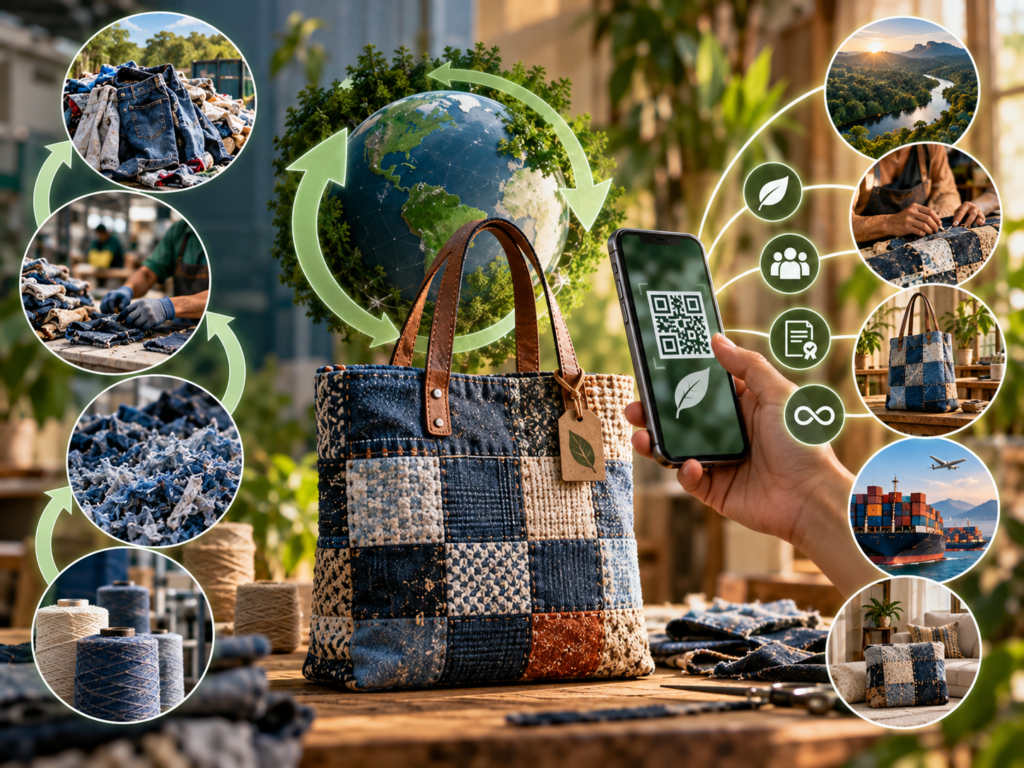
Consider a handmade bag crafted from a repurposed pair of jeans. The original garment is taken apart, its components are selected, and a craftsperson redesigns the material so that it serves a new purpose. The resulting bag has features that did not exist in the original product, but part of its material remains the same.
If the process is documented, the product can carry information about that transformation. Photographs can record the original material. Information about authorship can identify who carried out the intervention. Information about location and technique can provide context for the work.
In patchwork products, the logic may be based on batches: different sets of scraps are used to create the new piece. In other cases of upcycling, a specific object may have a direct connection to its previous form.
There is no single model that works for all supply chains. The passport must reflect the reality of the production process.
A Genealogy of Materials
When the relationships between products and materials begin to be preserved, a particularly interesting possibility emerges: constructing a kind of genealogy of matter.
Product A can provide materials for Product B. Product B, at the end of its useful life, can provide components for Product C. Each transformation creates a new commercial identity, but maintains some connection to previous cycles.
This does not mean that all materials can be tracked indefinitely. Industrial recycling processes may mix large volumes from different sources, making it impractical to maintain an individual traceability record. In other cases, batch-level traceability will be more appropriate.
The key point is to recognize that different chains require different levels of granularity.
This approach avoids exaggerated technological promises and brings the passport closer to operational reality.
SUIDChain, SUID, and SUIDPass
SUIDChain™ uses the SUID to manage digital product identity, organizing information related to origin, territory, authorship, materials, processes, batches, documents, evidence, and commercial presence.
SUIDPass serves as the interface between this identity and the physical product. Using a QR code, selected information can be accessed throughout the product’s supply chain.
For handicrafts and circular products, this makes it possible to preserve elements that often disappear when the item is separated from its original maker. A buyer located in another country can access information about the maker, the region, and the production process without having to personally know who made the object.
This capability can be particularly relevant in digital marketplaces, where the product and the buyer are geographically separated and much of the decision depends on the information available on the screen.
Evidence must accompany the information
A digital passport, however, should not automatically make any registered information verifiable.
If the manufacturer states that a certain material has been recycled, that is a self-declaration. If there is supplier documentation, that provides another layer of evidence. If a certain attribute has independent certification, that provides another form of proof.
Preserving these differences is essential.
Traceability can link pieces of evidence. It should not obscure their different natures.
This distinction also helps small producers. An artisanal supply chain that does not yet have complex certifications can start by organizing existing documents, batches, photographs, and statements. Over time, new evidence can be incorporated.
The passport thus becomes an evolving infrastructure.
When a Passport Generates Intelligence
Viewing a single product is just one aspect of this architecture's potential. When thousands of digital identities begin to generate structured data, it becomes possible to analyze broader patterns.
SUID Intelligence adds this layer by correlating information on trajectory, life cycle, commercial presence, and market signals.
For a circular economy organization, this can help it understand which materials are entering new cycles, which techniques are used, which products reach specific markets, and how collections circulate commercially.
Instead of keeping traceability separate from business management, a bridge is created between production data and business intelligence.
SERX and the Next Cycle: Accessing Markets
Handcrafted and upcycled products can find opportunities outside their home markets, especially when design, craftsmanship, origin, and materials set them apart. But gaining international access requires more than just a good story.
It is necessary to understand logistics, documentation, production capacity, distribution channels, requirements, and business strategy.
SERX— the SUIDChain Export Readiness Index—addresses this aspect by helping organizations assess their readiness for internationalization. In this way, digital identity, intelligence, and export readiness address different aspects of the same challenge: how to transform production attributes into structured information and, subsequently, into the ability to access markets.
A passport does not make a product sustainable
There is one key caveat: no digital passport automatically makes a product sustainable, circular, or responsible.
A QR code does not create traceability. Blockchain does not correct an improper source. A digital identity does not replace good production practices.
Technology can record and link information. The quality of the chain continues to depend on the actual practices that take place in the physical world.
This distinction will be essential to prevent the digitization of sustainability from merely creating another layer of marketing.
When Matter Begins to Store Memories
Crafts, patchwork, and upcycling demonstrate something that linear production systems often overlook: materials don’t have to have just one story.
A piece of fabric can be used in different products. A piece of wood can serve different purposes. An object can be taken apart and put back together. Every transformation involves work, knowledge, decision-making, and value.
The challenge for the next generation of traceability systems may well be to preserve these relationships.
If we can connect origin, recovery, transformation, authorship, evidence, and new cycles, we’ll begin to build something greater than just a product database.
We'll start building a memory for the lesson.
And in an economy that aims to become increasingly circular, knowing where a material came from can become just as important as knowing where it will go next.