From the Forest to the Product: Why Traceability Can Become an Export Asset for Brazilian Furniture and Home Decor

When a piece of Brazilian furniture arrives at a showroom in another country, becomes part of a hotel project, is included in an international distributor’s catalog, or is featured on a global marketplace, what the buyer sees is the end result of a much longer supply chain. They notice the design, finish, dimensions, functionality, materials, and price, but they can hardly tell right away where the wood came from, what species was used, who supplied the raw material, which lots were used in manufacturing, what documents pertain to its origin, or what certifications may be associated with the supply chain.
There is, therefore, a significant gap between what the product physically represents and the amount of information required to bring it to market. For Brazilian furniture, home decor, and objects made from forest resources, narrowing this gap can become part of the internationalization strategy.
This discussion is particularly relevant because international trade is becoming increasingly data-intensive with regard to products and supply chains. Origin, composition, suppliers, documentation, compliance, and environmental evidence are beginning to occupy a space that previously belonged almost exclusively to technical and commercial specifications.
This does not mean that all markets, buyers, or product categories are subject to the same requirements, nor that traceability alone guarantees market access. It means that the ability to organize, retrieve, and share reliable information about the supply chain is becoming a key business competency. For Brazil, which combines forest resources, the furniture industry, design, handicrafts, and territorial diversity, there is an additional opportunity: ensuring that attributes that are currently invisible can accompany the product all the way to the international market.
A piece of furniture begins long before it reaches the factory
A table doesn’t begin when the wood enters the production line. A chair doesn’t begin when the designer finishes the sketch. A decorative object doesn’t begin when it is finished. Before any of these stages, there were raw materials, the region, suppliers, transportation, processing, and a series of production decisions.
The problem is that, along the way, information tends to become fragmented. The supplier is registered in the ERP system, the documentation remains in a folder, the batch appears in the production system, any certification is managed separately, the technical data sheet is in the catalog, and the information used by marketing is stored in another environment. By the time the product finally reaches the international buyer, all of this wealth of information may have been reduced to just a few lines: “Made in Brazil,” “wood,” dimensions, and weight.
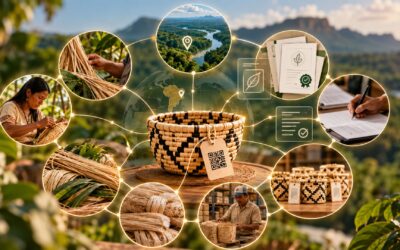
It is precisely at this juncture that digital traceability begins to take on greater importance. The goal should not simply be to accumulate more documents, but to establish connections between existing information. Product, raw material, species, region, supplier, lot, documents, certifications, production facility, and commercial destination can form a data chain capable of tracking the product’s identity. The more structured these relationships are, the greater the company’s ability to answer questions about what it produces without having to manually reconstruct the chain every time a buyer, auditor, or business partner makes a request.
FSC, documents, and digital identity serve different purposes
For certified supply chains, the FSC—Forest Stewardship Council—can serve as an important layer of evidence. Chain-of-Custody certification has its own rules and scope for tracking certified materials throughout participating organizations. In Brazil, there are also official control mechanisms for forest products subject to the corresponding regulations, such as DOF and DOF+ Traceability. These systems serve specific purposes and should not be confused with a Digital Product Passport.
This distinction is fundamental. Certification verifies compliance with a specific standard. Official documentation holds the authority and purpose assigned by the system that issued it. A traceability system establishes relationships between events and elements in a chain. A Digital Product Passport can organize and connect product-related information. One technology does not automatically replace the other. Value arises precisely when we are able to preserve the nature of each piece of evidence while simultaneously establishing relationships between them.
SUIDChain's Proposal for Product Identity
In SUIDChain™, this architecture begins with the SUID, a unique digital identity capable of organizing product-related information. For a piece of furniture, for example, this identity can link data on materials, species, origin, region, supplier, processes, lots, documents, authorship, applicable certifications, and commercial presence. The idea is not to transform all these elements into a single sustainability statement, but to allow each piece of information to remain linked to its source and the context in which it was produced.
This distinction is important because a product can have multiple levels of evidence. One piece of information may come from official documentation; another, from independent certification; another may be a production record; and yet another, a manufacturer’s statement. When all of these appear as if they have the same level of verification, the technology creates the appearance of trust without necessarily improving the quality of the information. The SUIDChain architecture aims to work in the opposite direction: connecting pieces of evidence while preserving the identity of each one.
SUIDPass: When Information Crosses the Border Along with the Product
SUIDPass bridges the gap between this digital identity and the physical product. Through a QR code, different audiences can access specific layers of information. A consumer can view the product’s origin, materials, manufacturer, and design. A B2B buyer may need to consult specifications, documents, or additional evidence. The company can store sensitive data in restricted-access environments. This means that a digital passport does not have to mean unrestricted exposure of the supply chain. On the contrary, a mature architecture requires governance, access levels, and a clear definition of which information is public, private, or intended for specific partners.
For exporters, this feature is particularly important. Today, much of the information remains in the country of origin, while only the physical item crosses the border. With a persistent digital identity, part of the product’s history can travel with it. The importer receives not just a table, but access to structured information about that table. The retailer can use selected attributes in its marketing communications. Consumers can better understand the product they are purchasing. The company, in turn, maintains a digital relationship with the product it has brought to market.
SUID Intelligence: Track Where It Came From and Understand Where It Went
There is also a second dimension that is often missing from traditional systems. Traceability typically ends once it can determine where a given material came from. But from a business perspective, another question is equally important: where did the product go? This is where SUID Intelligence expands the offering. By linking digital identity to indicators of commercial presence, market trajectory, life cycle, and other available data, it becomes possible to build intelligence about the product’s subsequent journey.
For a Brazilian furniture and home decor manufacturer, this perspective can link sustainability and business strategy. Certain products may have a stronger presence in specific markets; certain materials may be associated with categories that enjoy greater international acceptance; certain collections may be distributed through specific channels. Traceability thus shifts its focus from looking exclusively backward and begins to generate insights into the product’s journey after manufacturing.
SERX: Traceability Does Not Mean Readiness for Export
There is, however, a limit that must be acknowledged. A well-documented product does not mean that your company is ready to export. Internationalization involves business strategy, communication, digital presence, documentation, logistics, pricing, production capacity, distribution channels, and an understanding of target markets. This is where the SERX — SUIDChain Export Readiness Index serves as a complementary layer, assessing aspects related to an organization’s readiness for international markets.
The logic of the ecosystem, therefore, involves different questions. SERX monitors the company’s preparations. SUID structures the product’s identity. SUIDPass connects that identity to the physical object. SUID Intelligence expands the analysis to include the product’s commercial trajectory and lifecycle. These are not four solutions to the same problem, but rather different layers of an architecture designed for products and companies that need to operate within increasingly information-intensive supply chains.
Export products without leaving your identity behind
Brazil has what it takes to compete internationally not only as a supplier of raw materials, but also through products with higher added value. A chair can combine wood, original design, industrial capacity, local context, production techniques, and a documented supply chain. A light fixture can combine natural raw materials, Brazilian manufacturing, and original design. A decorative object can convey information about the species, origin, and manufacturing process. The problem is that much of this value remains invisible when there is no infrastructure to link it to the product.
Traceability does not guarantee higher prices, sustainability, or exports. But it can reduce a significant gap: the discrepancy between what a company knows about its product and what it can demonstrate to the market. In international supply chains where buyers need to better understand their suppliers, this discrepancy tends to become increasingly important.
The opportunity lies precisely in ensuring that the transformation of raw materials into products does not also result in the loss of their identity. Forest → territory → raw material → supplier → industry → design → product → market. When these relationships remain interconnected, Brazilian products can cross borders carrying not only their physical form but also a framework of information and evidence.
Because a table doesn't start at the factory. And its story doesn't have to end when it leaves the factory.