From Product to Marketplace: Why Traceability Is Becoming a Layer of Trust in Global E-Commerce
E-commerce has dramatically reduced one of the long-standing barriers faced by small producers, independent brands, and specialty businesses: the distance between producers and consumers.
Today, an artisan based in rural Brazil can have their product presented to a professional buyer on another continent; a small brand can participate in B2B platforms without having its own sales infrastructure in the destination country; and natural products, food, handmade items, home decor, and countless other goods can circulate through various marketplaces even before the producer, distributor, and consumer have any direct contact.
This transformation has expanded access to markets, but it has also created a new challenge. While geographic distance has shrunk in the digital environment, informational distance has not always kept pace with this evolution. In many transactions, buyers are aware only of what fits on the product page: a photo, title, description, price, reviews, and delivery time.
The greater the distance between production and consumption, the greater the information asymmetry may be—and, consequently, the greater the need to build trust through other means.
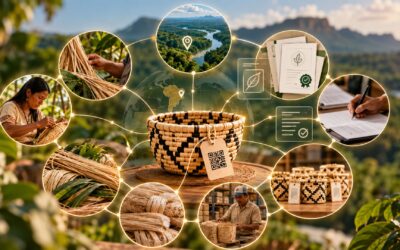
This problem becomes particularly evident when visually similar products have completely different production histories. Imagine two handmade baskets displayed side by side on a marketplace. The photos may look similar, the dimensions may be nearly the same, and their uses may be identical.
However, one of them may have been produced by a specific community, using a particular plant fiber, within a known territory, and through techniques passed down from generation to generation, while the other may be an industrial reproduction whose aesthetic merely evokes that of a handcrafted item. Something similar happens with natural ingredients.
Two bottles of vegetable oil may appear identical on screen, even though they have completely different origins, producers, processing methods, batches, documentation, and supply chains. When the digital environment displays only what is visually perceptible, key attributes that drive a product’s economic differentiation remain invisible.
The challenge is no longer simply to tell a story, but rather to create the conditions under which relevant information can be linked to the product in a structured way and, when necessary, supported by the corresponding evidence.
From the registration form to a digital product identity
Traditional e-commerce architecture was built around the product record. SKU, name, category, description, price, inventory, photos, weight, and dimensions are essential elements for a digital operation to function, but this structure was not necessarily designed to preserve a product’s history as it moves through different agents and sales channels.
An item registered by a producer may be assigned a new identifier when it enters a distributor’s system, a different description when it is published on a B2B platform, and a new record when it reaches a B2C marketplace. At each stage of this process, information may be summarized, reinterpreted, or simply discarded. The product ends up accumulating commercial records, but this does not mean that it is preserving a persistent informational identity.
Digital traceability adds precisely this layer. It does not need to replace ERP, SKU, marketplace, logistics systems, or sales management tools. Its role can be to connect information related to a product’s identity—origin, territory, authorship, materials, processes, suppliers, batches, documents, and evidence—allowing different systems and stakeholders to access the information relevant to their role in the supply chain.
Thus, an ad posted on a particular marketplace is no longer the sole digital representation of that product but becomes one of the commercial manifestations of a broader identity. This shift may seem conceptual, but it has important practical consequences, especially in supply chains where attributes such as origin, production, authorship, or compliance are part of the value proposition.
B2B and B2C don't ask the same questions
One of the mistakes in a transparency strategy is to assume that providing more information simply means showing everything to everyone. Consumers, distributors, importers, and professional buyers have different needs. A consumer might want to know who produced a particular item, where it came from, what materials were used, what story is associated with that item, or how to properly care for it.
A B2B buyer may need to delve into issues related to supplier identification, composition, production capacity, country of origin, batches, documentation, declarations of conformity, and evidence supporting certain commercial attributes. An importer, on the other hand, may need to access additional information that should not necessarily be publicly available.
A well-structured digital identity makes it possible to work with these different layers without turning transparency into indiscriminate data exposure. Information can be organized and presented according to context, authorization, and business needs.
This is particularly important for supply chains involving natural products, food, handicrafts, handmade goods, and the bioeconomy, where valuable characteristics are often scattered across documents, people, organizations, and different stages of production. Traceability thus comes to play a role that goes beyond simply tracking movement: it helps organize the product’s history.
Reducing Information Asymmetry
In an international negotiation, the producer and the buyer often have very different levels of knowledge about what is being negotiated. The producer has in-depth knowledge of their materials, processes, territory, and history. The buyer, located thousands of kilometers away, knows only what they have seen in a catalog or found on a platform.
This difference creates information asymmetry. Traceability does not eliminate commercial risk nor does it, on its own, guarantee that a claim is true, but it can bridge this gap by organizing data, identifying its sources, and linking evidence to the claim being made.
For small producers, this capability can be particularly important. Large companies have well-known brands, compliance departments, international distributors, sales teams, and established systems. Small producers often possess extremely valuable attributes but are unable to transform them into structured information.
Origin, traditional knowledge, production process, craftsmanship, materials, or territorial ties may exist in concrete terms and yet remain invisible at the time of the purchasing decision. When this information is organized, the product ceases to compete solely on the basis of appearance or price and begins to offer other factors for evaluation.
A QR code is for access, not tracking
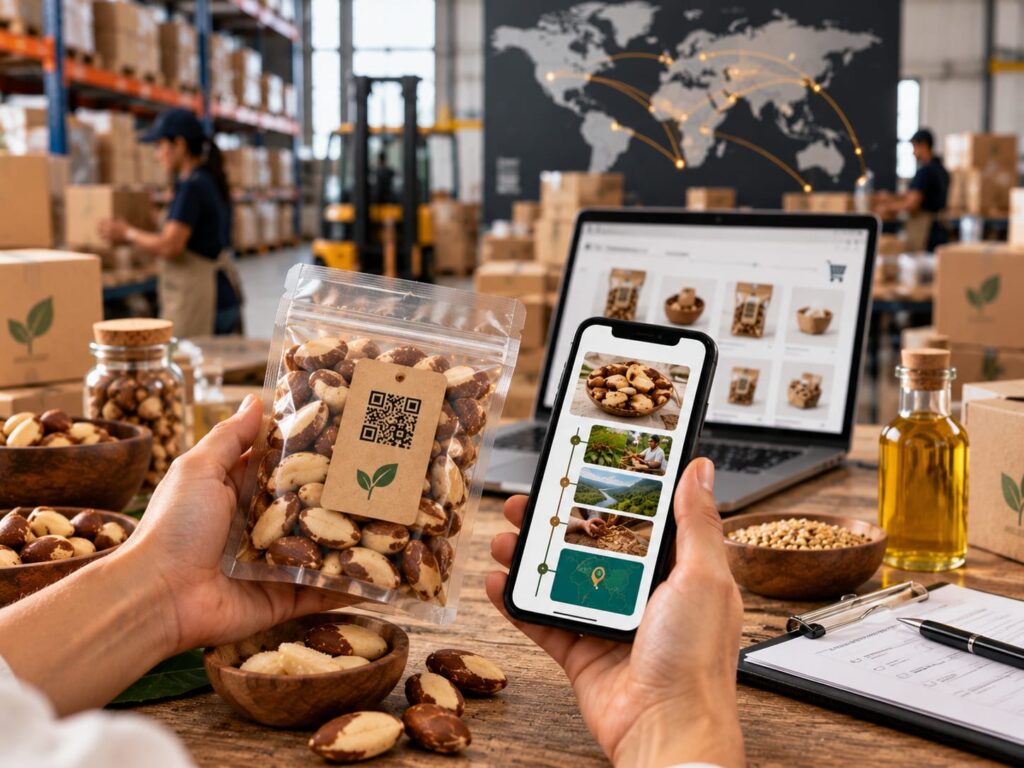
It’s important to avoid a common misconception: placing a QR code on packaging does not automatically make a product traceable. The QR code is merely a means of access. The relevant question is what lies behind it. If the code merely directs users to a static promotional page, there is digital communication, but not necessarily a traceability architecture. When it connects the physical object to a structured identity—one capable of linking origin, materials, supply chain participants, documents, batches, and evidence—its function becomes far more significant.
In the SUIDChain ecosystem, this logic is evident in the combination of the product’s digital identity and the SUIDPass, which can serve as a gateway to the information associated with that identity. The value, however, does not lie in the QR code alone. It lies in the structure that connects the product, data, sources, and evidence. This distinction is fundamental because it prevents traceability from being reduced to a mere aesthetic packaging solution and places information governance at the center of the discussion.
When the product begins to load its own memory
A persistent identity creates another possibility: the marketplace no longer represents the product’s digital birth. Before reaching the platform, that item already had raw materials, territory, people, processes, transformation, and documents. After the sale, its journey can also continue through distributors, new sellers, other countries, and different channels. If this information remains linked to the same identity, the product comes to carry a kind of digital memory that does not need to be reconstructed with every transaction.
This memory can also generate insights. When products have persistent identities, it becomes possible to track not only where they came from, but also how they are circulating commercially. In which markets do they appear?
Through which channels do they pass? Where are their identities verified? Which products generate the most interest? What attributes are associated with a presence in certain markets? This is where traceability begins to take on the characteristics of a layer of business intelligence. In the SUIDChain ecosystem, SUID Intelligence broadens this perspective by considering signals generated by the products’ commercial trajectory, transforming part of the supply chain into information that is potentially useful for brands, producers, and organizations.
Trust could be the next layer of e-commerce
Marketplaces have solved the problem of discovery in an extraordinary way. A buyer can find thousands of suppliers and products in seconds. The next challenge is to help them better understand what they’ve found.
For highly standardized products, price, availability, delivery time, and reviews may continue to be the primary criteria. However, in categories where origin, authorship, territory, materials, processes, or specific evidence are part of the value proposition, a conventional product listing may be insufficient.
Traceability does not replace branding, certification, quality, auditing, compliance, or business relationships. Nor does it automatically turn a statement into a proven fact. Its value lies in building the infrastructure capable of linking a statement to the information and evidence that can support it, making it clear what has been stated, documented, verified, or certified.
In digital markets where buyers and producers may never physically meet, this architecture can bridge one of the most difficult gaps to overcome in global trade: not the distance between countries, but the gap between what a product actually is and what the market is able to learn about it.