From Statement to Evidence: Why Credibility Will Be One of Sustainability’s Key Assets

For many years, a significant part of the sustainability agenda has revolved around commitments. Companies have set environmental goals, made climate commitments, established supplier policies, developed social programs, and begun communicating their ESG strategies to the market.
This movement has helped bring environmental and social issues to the forefront of business decision-making, but it has also created a new challenge: the more sustainability-related statements an organization makes, the greater the need to demonstrate what underpins each one. The discussion is therefore beginning to shift from what an organization claims to do to what it can actually demonstrate.
It is not enough to say that a raw material comes from a responsible source, that a supply chain is traceable, that a particular process has a positive impact, or that a product meets social and environmental criteria. It is necessary to understand where this information came from, who reported it, what records exist, how it was compiled, and, when necessary, who verified it.
This transformation places credibility in an increasingly strategic position. Credibility does not stem simply from the amount of data presented or from the technological sophistication used to store it. It is built on a combination of transparency, governance, methodology, information quality, and the ability to provide evidence. A company may have thousands of records about its supply chain and still face difficulties in answering fundamental questions about the source of that information.
Similarly, a report may present dozens of indicators without making it clear how certain results were obtained. The challenge is not merely to produce more data, but to create the conditions necessary for that data to be understood within its context and used responsibly.
It is precisely at this point that an important distinction arises between a statement and evidence. A statement represents what someone claims about a particular product, process, or organization. Evidence is an element that helps support that claim. If a producer states that a certain material has a specific origin, for example, that information may be accompanied by production records, documents, lot identification, territorial data, or other sources.
Depending on the context, a third party may conduct an additional verification. What we should not do is treat all these levels as equivalent. Self-reported information, a document issued by a third party, an independent audit, and an accredited certification may serve different purposes and have different levels of validation . Transparency also means making it clear what level of evidence is available.
This distinction is particularly important because there is a tendency to associate verifiable evidence exclusively with certification. Certifications are important tools and, in many contexts, indispensable. However, not all information in a supply chain needs to be—or can be—certified. There are thousands of data points that contribute to a product’s history: producer, region, raw materials, process, batch, supplier, documentation, movement, and commercial destination.
Some of this information can be reported directly by the producer; other information can be substantiated by documentation; certain information can be verified by third parties; and some situations will require audits, testing, or formal certifications. Creating an evidence architecture means recognizing these differences and ensuring that each piece of information also carries its context of origin and validation.
This logic becomes even more important in light of the growing demands related to due diligence and risk management in supply chains. The further a company is from the source of its products and raw materials, the more difficult it may be to understand what happens in the early stages of the supply chain. A buyer may know its direct supplier, but not necessarily all the actors involved upstream.
Information can pass through different organizations, systems, and documents before reaching the company responsible for making a decision. Along the way, data can lose context, become outdated, or simply remain fragmented. In this scenario, establishing traceability does not simply mean physically tracking a product, but rather creating informational continuity among the different stakeholders involved in its journey.
For small-scale producers, artisans, cooperatives, and communities, this challenge takes on an additional dimension. Often, responsible practices, local knowledge, and information on origin exist, but there is little capacity to transform them into structured records. The absence of a sophisticated data infrastructure does not necessarily mean a lack of best practices.
However, when this information needs to circulate in formal markets, what cannot be demonstrated tends to be more difficult to recognize. The challenge for technology, therefore, should not simply be to require small producers to generate more documents, but to help them gradually organize evidence of what they are already doing, using tools that are compatible with their reality and preserving authorship and context.
There is also an important aspect related to sustainability claims. Terms such as “sustainable,” “responsible,” “ethical,” “low-carbon,” or “traceable” may seem objective, but they often depend on specific criteria.
The relevant question is no longer simply whether an organization uses a particular expression, but rather: what exactly does that expression mean in that context, and what evidence supports its use?
The more specific the claim, the greater the need for clarity regarding methodology, scope, and supporting documentation. This change is important for reducing the risk of turning sustainability into a collection of statements that are difficult to compare or verify.
Technology can play an important role in this evolution, but it must also be understood within its limitations. Blockchain can contribute to the integrity and audit trail of records, but it cannot determine on its own whether information originally entered is true. Artificial intelligence can analyze large volumes of data and identify inconsistencies, but its conclusions depend on the quality of the available information.
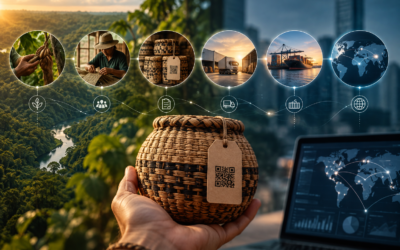
QR codes can make it easier to access a product’s history, but the code itself does not prove the origin of what it represents. Technology can protect, connect, organize, and analyze evidence; it should not be confused with the evidence itself. This distinction is essential for building truly reliable systems.
The next step may lie precisely in the creation of evidence ecosystems, in which information does not appear merely as isolated fields, but is linked to the product, the person responsible for the declaration, the time of entry, the corresponding document, and, where applicable, the mechanism used for its validation.
In this model, information can evolve. Data initially reported by the producer may later be supplemented with additional documentation, linked to a batch, undergo verification, or be part of a certification process. Rather than reconstructing the entire product history every time a new requirement arises, the supply chain gradually builds an organized record of evidence.
It is from this perspective that SUIDChain works with the digital identity of products. By linking information related to origin, territory, authorship, materials, processes, lots, documents, and commercial history, the goal is to create a framework in which evidence can track the product over time.
This does not mean attributing the same level of reliability to all information, nor does it mean replacing certification bodies, accreditation bodies, auditors, or regulatory authorities. On the contrary: an evidence architecture must make it possible to clearly distinguish between what has been declared, what has been documented, what has been verified, and what has been certified.
This distinction could become one of the most important elements of the next generation of sustainability systems. In an environment where companies, markets, consumers, financial institutions, and buyers are receiving ever-increasing volumes of information, credibility will not necessarily be earned by those who present the most data, but by those who can demonstrate where the data came from, how it was produced, and what evidence supports each claim.
This represents a significant shift: sustainability is no longer dependent solely on the ability to communicate commitments; it now requires an infrastructure capable of preserving a record of those commitments and demonstrating their implementation.
Perhaps, therefore, the most important question in the coming years will not simply be , “What is your commitment to sustainability?” The question may be much more concrete: “What can you demonstrate about it?”
It is in this transition from mere statements to evidence that transparency becomes credibility—and that data ceases to be merely records and instead becomes part of the process of building trust among products, companies, markets, and society.