Sustainability also means access to markets: a decent income, diversification, and resilience in small supply chains
When we talk about sustainability in supply chains, the first thing that usually comes to mind is environmental issues: reducing emissions, conserving biodiversity, using natural resources responsibly, combating deforestation, and adopting production processes with a lower environmental impact.
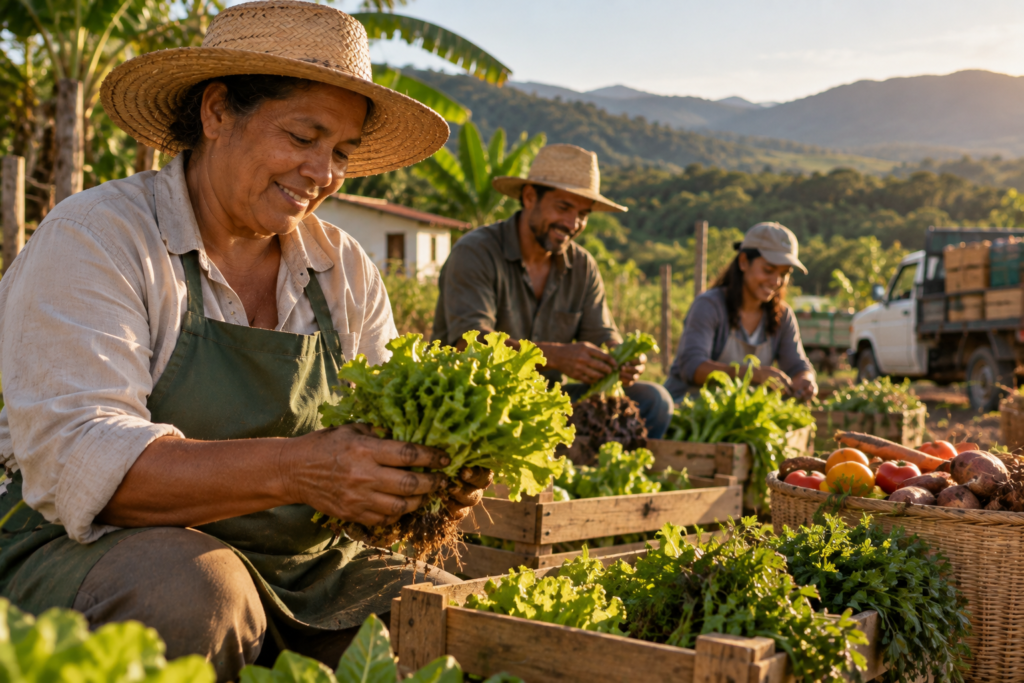
All of these elements are fundamental, but an environmentally responsible supply chain is not necessarily sustainable if the people responsible for maintaining it are unable to generate sufficient income, remain dependent on a few buyers, or face permanent barriers to accessing more structured markets. Sustainability also has an economic dimension, and this becomes especially relevant when we consider family farmers, artisans, cooperatives, traditional communities, and small-scale producers, who are at the source of countless value chains.
This line of thinking changes the way we analyze impact. Conserving a raw material, adopting good production practices, or meeting certain standards can yield significant environmental benefits, but we must also ask what happens to the people who do this work. Does the activity generate adequate income?
Is demand predictable? Can producers sell their products under fair conditions? Are there alternative markets, or does the entire production depend on a single buyer? Are there opportunities for young people to remain in the industry if they wish? When these questions are factored into the analysis, sustainability is no longer viewed solely from the perspective of the final product but also takes into account the supply chain’s ability to remain economically viable over time.
Reliance on a single buyer is a good example of this vulnerability. A community may develop a positive business relationship with a particular company, tailor its production, improve processes, and organize itself to meet demand. However, if virtually all of its income is concentrated in that relationship, there is a significant risk.
Changes in strategy, reduced orders, a switch in suppliers, or shifts in the market can quickly jeopardize production. This situation does not mean that long-term business relationships are negative—on the contrary, committed buyers can play an important role in the development of a supply chain. The problem lies in excessive concentration and a lack of alternatives, which can limit a producer’s economic autonomy and increase their vulnerability.
For this reason, market diversification can also be viewed as a sustainability strategy. A small producer who is able to access different buyers, regions, or distribution channels reduces their dependence on a single source of income and increases their bargaining power.
For a cooperative, a productive community, or a group of artisans, this diversification can provide greater stability in the face of fluctuations in demand.
However, entering new markets depends on more than just having a good product. It is necessary to be able to present it, demonstrate its origin, provide information on materials and processes, meet commercial and regulatory requirements, organize documentation, set prices, arrange logistics, and build trust with buyers who are often thousands of kilometers away.
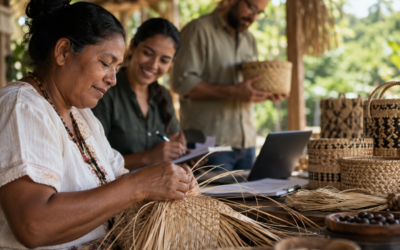
It is precisely at this point that one of the major imbalances in small supply chains becomes apparent. Many products have a strong regional identity, traditional knowledge, quality, and cultural value, but they reach the market with little structured information.
Producers have a deep understanding of what they do, but that knowledge isn’t always translated into the language used by buyers, importers, marketplaces, certification bodies, or financial institutions. The result is a paradox: there is value at the source, but part of that value becomes invisible as it moves through the supply chain. When the product’s history, production process, materials, origin, and supporting evidence do not accompany it, it may end up being evaluated solely on the basis of characteristics such as price, appearance, and availability.
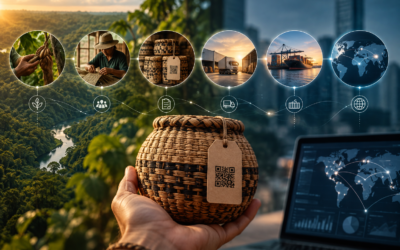
Turning this information into structured assets can help change this dynamic. Knowing who produced the product, where it was produced, what materials were used, what techniques were involved, which batch the product belongs to, and what documents or evidence are available creates a more consistent foundation for establishing business relationships.
This does not mean that telling a product’s story will automatically increase its price or guarantee new buyers. The market depends on demand, positioning, quality, competitiveness, and various other factors. However, structured information reduces information asymmetries and enhances the ability to demonstrate value, especially in supply chains where origin, region, production process, and impact are key differentiators.
The discussion on a living wage must also take center stage. A supply chain does not become sustainable simply because it holds a certification or meets a set of environmental criteria. If producers cannot sustain their operations financially, there is a structural problem. Similarly, adequate compensation cannot be analyzed in isolation from productivity, costs, local conditions, and the characteristics of each supply chain.
The challenge is to understand whether the value generated throughout the production process is creating the conditions that allow the people involved to remain in the industry with real economic prospects. Sustainability, in this sense, is closely related to the idea of economic resilience: the ability of a supply chain to weather changes, adapt, and continue to produce value without compromising the people and resources on which it depends.
This perspective also helps us understand the relationship between sustainability and family succession. In many artisanal, agricultural, and traditional activities, knowledge is passed down from one generation to the next. Techniques for cultivation, management, gathering, weaving, braiding, embroidery, processing raw materials, and countless other forms of knowledge depend on the continuity of the people who practice them.
However, it is unreasonable to expect a new generation to remain in a particular activity solely to preserve a tradition if it does not offer even minimally attractive economic conditions. The continuity of a craft must be a possibility, not an obligation. When an activity is valued, finds markets, generates income, and offers prospects for development, the conditions improve for that knowledge to continue being passed on to those who wish to preserve it.
Certification and production organization can contribute to this process, but they must be linked to tangible benefits. For a small producer, investing time and resources in meeting a standard will only make sense in the long run if that effort yields some return: better management, risk reduction, access to buyers, increased product value, or new business opportunities.
Otherwise, certification risks being perceived merely as a cost imposed by the strongest links in the chain. The same applies to traceability. Asking small producers to record more and more information without providing them with any value in return creates an unbalanced relationship. Data should not flow only from the bottom of the chain upward; insights, opportunities, and benefits must also flow back to those who generate that data.
This is perhaps one of the most important issues for the next generation of sustainability systems. For a long time, information about producers was collected primarily to meet the needs of buyers, audits, or compliance.
A more balanced digital infrastructure can enable this same information to be used to increase producers’ visibility, organize their career paths, identify gaps in their preparation, present evidence to new partners, and support their connection to different markets. Data ceases to be merely a reporting requirement and begins to function as an asset for those at the source of the supply chain.
It is from this perspective that the digital identity of products can play a significant role. By linking products, producers, regions, materials, processes, batches, documents, evidence, and commercial presence, it becomes possible to progressively build a structured record of what is produced.
In SUIDChain, this approach aims to enable information that is normally scattered to accompany the product throughout its journey, contributing not only to traceability but also to market readiness and business intelligence. This does not guarantee access to markets, financing, or increased income—and it would be incorrect to claim that technology, on its own, can produce these results. However, it can reduce the information barriers that currently hinder the participation of small-scale actors in more structured supply chains.
The challenge, therefore, is to ensure that sustainability and market access are no longer treated as separate agendas. Preserving biodiversity, reducing environmental impacts, and improving production practices are essential goals, but the sustainability of these changes also depends on the ability to generate economic value for those in the supply chain. For small-scale producers, artisans, and communities, access to markets, diversification of buyers, information, training, and a decent income are also key components of resilience.
Perhaps we need to broaden the question we ask when evaluating a sustainable supply chain. Not just “how was this product produced?”, but also “what conditions are we creating so that those who produce it can continue to do so, be valued, and gain access to new opportunities?”. Because a truly resilient supply chain is not just one that can trace its origins and reduce its impacts. It is one that manages to connect environmental responsibility, people, knowledge, income, and markets in a way that allows the value generated by sustainability to also reach those at the source.