From Product to Region: How Traceability, Climate, and Landscape Are Transforming the Management of Supply Chains

Every product comes from somewhere. This statement seems simple, but it takes on a much greater significance when we consider sustainability, traceability, and supply chain management.
For a long time, business systems were structured primarily to identify products, suppliers, and transactions: who supplied the goods, how much was purchased, when delivery took place, and where the goods were shipped. This information remains essential, but knowing the supplier does not necessarily mean understanding the context in which that product was produced. As climate, environmental, social, and regulatory issues increasingly influence global supply chains, an additional need arises: to understand the region behind the product’s origin.
A territory is not simply an address, a ZIP code, or a set of geographic coordinates. A territory has its own climate, water resources, biodiversity, infrastructure, logistical conditions, economic activities, communities, local knowledge, and unique productive characteristics.
It also has vulnerabilities. Droughts, floods, fires, changes in rainfall patterns, pressure on natural resources, or infrastructure challenges can directly affect the availability of a raw material and the continuity of a supply chain.
Therefore, when we associate a product with the region where it was produced, we add a layer of context that is rarely found in a traditional commercial registry. The origin ceases to be merely a point on the map and begins to explain some of the conditions that make that production possible.
In a country with Brazil’s level of territorial diversity, this approach becomes particularly relevant. The Amazon, the Cerrado, the Pantanal, and the Caatinga, for example, have profoundly different environmental, productive, and social characteristics, and even within each biome there are very distinct local realities.
A product from the Amazon may be associated with socio-biodiversity chains, traditional communities, agroforestry systems, or different production models. In the Cerrado, the Pantanal, or the Caatinga, other combinations of water availability, vegetation, infrastructure, production, and risks will be present. This means that using only the country or state as origin information can obscure a vast amount of context that is relevant to understanding a supply chain.
This shift in perspective also links traceability and security of supply. Imagine a company that has ten suppliers of a particular raw material. In a conventional analysis, this number might suggest a relatively diversified supply chain.
However, if eight of these suppliers are concentrated in the same region and subject to the same climatic or logistical risks, diversification may be much less than it appears. A prolonged drought, a flood, or an infrastructure disruption could affect several suppliers simultaneously. When traceability data is linked to geographic information, the supplier map also begins to serve as a map of exposure and dependency.
Climate change makes this analysis even more important. Climate should not be viewed merely as an environmental issue external to the company. Extreme weather events can affect production, the availability of raw materials, transportation, prices, and delivery capacity.
Gradual changes in temperature or precipitation can also alter production cycles over time. Thus, understanding where a supply chain is located can help organizations identify vulnerabilities and develop strategies for adaptation, diversification, and continuity. This does not mean that a geographic coordinate can predict the future of a supply chain, but rather that geographic information, when combined with other data, can significantly improve the quality of risk analysis.
The same reasoning applies to deforestation and land-use changes. These issues are not limited to the environmental agenda. Depending on the supply chain and the market, they may involve compliance, reputation, market access, the future availability of resources, and relationships with buyers.
Knowing the territorial origin can contribute to more accurate assessments, but again, it is important to distinguish between traceability and automatic conclusions. Knowing where a particular product was produced does not, by itself, prove whether or not deforestation was associated with that production. To do so requires methodologies, adequate data, and specific evidence. Traceability provides the link; other layers of information help build the analysis.
This is precisely where the landscape approach broadens our perspective. A supply chain does not exist in isolation within a property, factory, or community. Different economic activities share water, infrastructure, natural resources, services, and territories. Companies, producers, governments, associations, cooperatives, and communities may be connected to the same landscape, even if they are part of different supply chains.
Focusing on a single supplier may make sense for certain audit or compliance processes, but some sustainability challenges can only be understood when we broaden our perspective and examine the relationships surrounding that supplier.
However, there is a risk in this evolution: reducing territory to nothing more than a set of environmental layers on a digital map. Territories are also made up of people. Family farmers, artisans, workers, cooperatives, indigenous peoples, traditional communities, small businesses, and local organizations all contribute to the economic and social fabric of these landscapes. Their income levels, access to markets, infrastructure, knowledge, and capacity to adapt also influence the resilience of the supply chain. A territorial analysis that considers carbon, vegetation, and water but ignores those who live and produce in that territory remains incomplete.
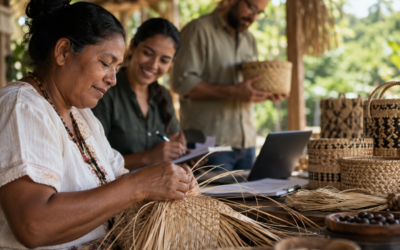
This human dimension is especially important when products are linked to knowledge and practices passed down through generations. A natural fiber is not just a raw material. There may be specific knowledge regarding its harvesting, preparation, dyeing, or weaving.
An element of biodiversity can embody management practices developed over decades. A handcrafted product can represent techniques deeply rooted in a community’s identity. Structuring this information does not mean appropriating that knowledge or reducing culture to a mere database field. It means recognizing that the identity of certain products is directly connected to the people and territories that make their existence possible.
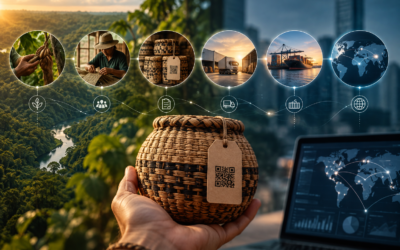
When this perspective is integrated into traceability, it paves the way for a much richer information framework. Instead of simply recording the product, supplier, and lot, we can begin to link origin, region, raw materials, producer, organization, process, documents, evidence, and commercial history.
Over time, this information can support various types of analysis. A company can identify geographic concentrations of suppliers, understand which products depend on certain raw materials, identify gaps in documentation, or assess where it needs to deepen its risk analysis. For impact projects and financial instruments, structured information can also support evaluation and monitoring processes, although its existence alone does not guarantee investment or access to credit.
This transformation also changes the way we think about technology. Maps, artificial intelligence, remote sensing, blockchain, and various databases can help expand our ability to observe production chains, but none of these technologies can replace the need for context. A satellite image may reveal characteristics of an area, but it does not, on its own, tell the story of those who produce there.
A digital record can preserve certain information, but it does not automatically guarantee its accuracy. An algorithm can identify correlations, but it requires adequate data and governance to produce reliable analyses. Technology gains value when it connects evidence and context, not when it attempts to replace the reality it is meant to represent.
It is from this perspective that SUIDChain works with the concept of digital product identity. The goal is to link information related to origin, region, authorship, materials, processes, batches, documents, evidence, and commercial history, allowing the product to be understood beyond its conventional registration details.
The territory becomes one of the dimensions of that identity, creating the conditions to relate what is produced to the context in which it is produced. This does not replace certifications, environmental assessments, or specialized analyses when they are necessary, but it creates a framework within which different types of evidence can be organized and connected.
The next generation of traceability will likely not be defined solely by the ability to track a product from point A to point B. It will become increasingly contextual. It will need to understand not only who supplied a given item, but also which region it came from, which people and processes are involved in its production, what evidence exists, and what factors may influence the continuity of that supply chain. Traceability, therefore, ceases to represent merely a path and begins to represent a system of relationships.
Because before a product receives an SKU, enters inventory, crosses a border, or reaches a consumer, every product begins somewhere. And understanding that place can be just as important as tracking the path it takes afterward. A product’s identity does not begin with the code that identifies it. It begins with the territory, the people, the materials, and the conditions that made its existence possible.