Traceability Beyond Origin: Data, Evidence, and Intelligence for Supply Chains
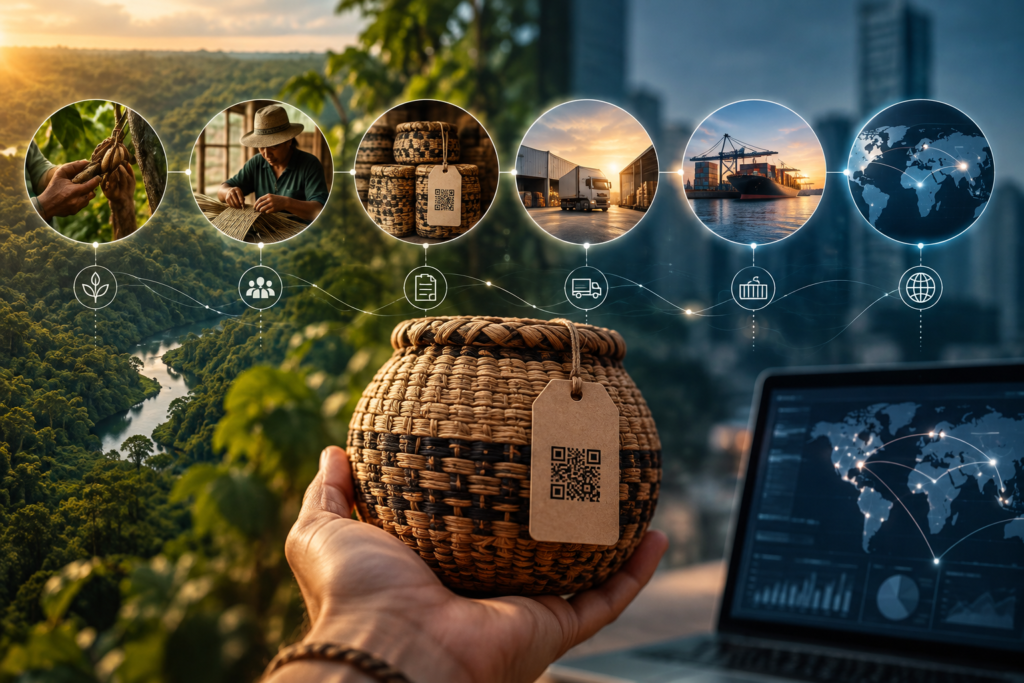
For a long time, talking about traceability meant answering a relatively straightforward question: Where did this product come from? Identifying its origin remains essential, but that answer no longer captures the full complexity of today’s supply chains.
As products move through different suppliers, regions, processes, and markets, there is a growing need to understand who was involved in their production, what materials were used, where each step took place, what documents are associated with the process, and, most importantly, what evidence supports the information provided.
Traceability thus begins to move beyond being merely a mechanism for tracking an item’s journey and takes on a more strategic role: structuring information that supports transparency, compliance, risk management, and preparation for new markets.
This transformation is taking place at a time when companies generate a massive amount of data but are not always able to turn it into knowledge about their own supply chains. Information about suppliers may be in the ERP system, certificates may be stored in folders, production documents may be in another system, logistics records may be managed by third parties, and proof of origin may be maintained by the producer.
The data exists, but it remains fragmented. And there is a significant difference between data, evidence, and intelligence. Data is recorded information; evidence adds elements capable of supporting or contextualizing a particular statement; and intelligence emerges when different data and evidence are linked to support a decision. This distinction becomes increasingly important in environments where it is not enough to simply state a practice: it is necessary to demonstrate how a particular piece of information was constructed and what elements can support it.
When this logic is applied to the product, a different perspective on traceability emerges. Imagine a handmade item produced with raw materials sourced from a community in the Amazon. A traditional business database would likely store the name, SKU, price, inventory, category, and supplier.
However, there is a much bigger story behind that product: what raw material was used, where it came from, who was involved in its production, what techniques were employed, whether a cooperative or organization was involved, which batch the product belongs to, what documents trace its origin, and which markets it has already been sold to. When this information is organized and linked over time, the product goes beyond simply having a record and begins to build a digital identity capable of connecting its origin to its journey.
This set of information also expands the role of traceability in risk management. A company may discover that a particular raw material is overly dependent on a small number of suppliers, that a large portion of its production is concentrated in a region exposed to weather events, or that certain links in the chain have recurring documentation gaps. These relationships are unlikely to emerge when each piece of information is analyzed in isolation.
Once the data is connected, the product map begins to align with the supplier map, and, gradually, the supplier map aligns with the risk map. It is at this point that traceability begins to interact directly with compliance, auditing, sustainability, operations, supplier management, finance, and risk, ceasing to be a function limited to logistics or quality.
This capability also becomes particularly important when considering international expansion. Different markets have different requirements, and depending on the product category, there may be requirements related to composition, origin, safety, labeling, documentation, sustainability, production processes, or certifications.
This means that preparation for a new market begins long before the export transaction takes place. It starts with the ability to have a deep understanding of the product and to organize the information needed to demonstrate its compliance. In this context, traceability can evolve from the traditional question— “Where did this product come from?” —to a more strategic one: “What evidence already exists about this product, and what is still needed to prepare it for a specific market?” This shift brings traceability closer to market readiness, transforming information about origin into an asset for business expansion.
This challenge is even greater for small producers, artisans, cooperatives, family businesses, and traditional communities. Large organizations typically have management systems, legal teams, compliance departments, and structures dedicated to supplier oversight.
Small-scale actors may have in-depth knowledge of the territory, raw materials, techniques, and processes, but often this information is not structured in a way that is recognizable by the systems used by the market. There is, therefore, an important difference between not having information and not having structured information. A community may have in-depth knowledge of its production and yet still face difficulties in transforming that knowledge into documents and evidence that can be presented to buyers, certifying bodies, or business partners.
This is precisely where digitization can play an inclusive role, provided it is designed with the realities of those on the front lines in mind. Digitization should not simply mean creating more forms or requiring small-scale producers to feed data into complex systems.
It must mean finding accessible ways to transform information that already exists in the physical world into structured records, while preserving context, authorship, and territorial ties. By doing so, technology can help reduce some of the information asymmetry between small producers and organizations with sophisticated management structures, increasing the ability to demonstrate origin, processes, and evidence without assuming that all participants in the supply chain have the same level of technological maturity.
As this information accumulates over time, a second transformation takes place: traceability begins to generate insights. Structured data can reveal concentrations of suppliers, dependence on certain markets, gaps in documentation, certification requirements, regional risks, trade flows, and opportunities for diversification.
Traceability, therefore, is no longer limited to looking exclusively at the past; it also begins to help prepare for the future. Instead of merely reconstructing a product’s journey, it becomes possible to use its history to understand vulnerabilities, identify areas for improvement, and support decisions regarding markets, suppliers, and expansion strategies.
There is, however, one crucial caveat: digitizing information does not automatically make it true. Blockchain, artificial intelligence, QR codes, and other technologies can improve the integrity, organization, availability, and connectivity of data, but they do not eliminate the need for governance.
It is necessary to understand who reported a particular piece of information, when it was recorded, what documents support it, and, when applicable, who verified it. Verifiable evidence does not mean that all information must necessarily go through a certification body; it means that there must be clarity regarding its source, its level of validation, and the elements that support that statement. Without this distinction, there is a risk of reducing traceability to merely a technological layer of communication.
Perhaps, therefore, the next step in traceability does not lie in creating more isolated databases, but in building evidence ecosystems capable of connecting products, producers, regions, materials, processes, lots, documents, certifications, and supply chains.
This is the approach SUIDChain takes to structuring the digital identity of products, organizing information that normally remains fragmented and creating continuity between origin, production, evidence, and market presence. The goal is not to replace certification bodies, auditors, regulatory authorities, or management systems, but to build a layer that allows different types of information to accompany the product and be used as new needs arise.
Traceability in the future, therefore, tends to go far beyond simply answering where a product has been. Its true value may lie in the ability to understand what we know about it, where that information came from, what evidence supports it, and what insights can be derived from it. When this happens, the classic question of traceability— “Where did it come from?” —takes on a new dimension: “What can we demonstrate about this product, and what new avenues might this evidence open up?”